
Why You Keep Failing Practice Exams (And How to Actually Fix It)
You have been studying for weeks. You have watched the videos, read the books, taken the practice tests. But your scores are not budging. You are stuck at 65%, 70%, maybe 75% - nowhere near the passing mark you need. Here is the uncomfortable truth: you are not failing because you are not smart enough. You are failing because you are using study techniques that feel productive but do not actually work. And until you change your approach, you will stay stuck.
The Illusion of Learning: Why Your Brain is Tricking You
Humans are excellent at fooling themselves into thinking they are learning. Rereading the same chapter for the fourth time feels comfortable and familiar. Your brain sees the words and thinks, "I know this." But familiarity is not understanding. If you cannot close the book and explain the concept in your own words, you do not know it. You just recognise it.
The worst offender is passive video watching. You sit through a 45-minute lecture, walk away feeling accomplished, and have retained almost nothing. Your brain was in receive mode, not process mode. Without active engagement, the information goes in one ear and out the other. The completion bar moves; the memory does not.
Why Practice Exams Alone Do Not Work
Here is what happens when most people take practice exams:
Step 1: Answer a question wrong Step 2: See the correct answer Step 3: Think "oh right, that makes sense" Step 4: Move to the next question
You just learned nothing. Seeing the right answer creates an illusion of competence. Your brain says, "Yeah, I knew that," even though you did not. This is called the "fluency illusion" - and it is destroying your study efficiency.
To actually learn from a wrong answer, you need to understand *why* your reasoning failed. What assumption led you astray? What concept did you misapply? What knowledge gap caused the error? Without that analysis, you will make the same mistake again on exam day.
The Science of Actually Remembering: Active Recall
There is one study technique that beats everything else: active recall. Instead of rereading, you force your brain to retrieve information from memory. The act of retrieval itself is what builds neural pathways and moves knowledge into long-term storage.
The research is clear. Students who use active recall outperform those who use passive review by 50% or more on exams. It is not because they are smarter - it is because they are studying smarter.
But here is the problem: active recall is uncomfortable. It feels slow and frustrating because you are constantly confronting what you do not know. Your brain would much rather reread comfortable material than struggle to retrieve facts. This is why most people avoid it - and why most people fail.
How ReadRoost Makes Active Recall the Default
ReadRoost is built around one core idea: every minute on the platform should be a retrieval moment, not a review moment.
Validated practice questions, not flashcards of facts. Every question in every ReadRoost pack runs Kimi K2 generation through Claude Opus validation against the official documentation. The questions are scenario-based judgment calls, not vocabulary recall. Drilling them is active recall by definition: you have to retrieve the concept, apply it to the scenario, and pick the BEST answer before you see whether you got it right.
Mistake-driven review. When you get a question wrong, it goes back to the top of your queue. The questions you breeze through fall to the bottom. Your study time concentrates on the topics you actually need to drill, not the ones you already know.
Spaced repetition. Topics you struggle with come back at increasing intervals - the next day, three days later, a week later, a month later. The schedule is what stops the forgetting curve. Done by the platform, so you do not have to remember to revisit anything yourself.
Immediate, cited explanations. Every wrong answer comes with an explanation that traces back to the official source - Microsoft Learn for Azure, AWS Skill Builder for AWS, the CompTIA objectives PDF for CompTIA. You get the why, with a citation, the moment you need it.
No flashcard deck to build. No notes to organise. The active-recall workflow is the platform.
Real Results: From Stuck to Certified
Here is what changes when you switch from passive review to drill-driven active recall:
Week 1: You stop rereading. You sit down and answer questions cold, see the explanations, and let the platform queue your weak topics for tomorrow. Uncomfortable. The discomfort is the point.
Week 2: You notice patterns. Certain domains keep coming back at the top of your queue - those are your real gaps. You are no longer guessing what to study; the mistake-driven queue is telling you.
Week 3: Your practice scores start climbing. Not because you memorised more answers, but because you have actually retrieved each concept dozens of times under simulated exam conditions. Your reasoning gets faster. Wrong answers become rare.
Week 4: You walk into exam day knowing you have done the drill. The questions feel familiar because you have answered hundreds like them - and you have answered the ones that map to your weak topics specifically.
Stop Studying Harder. Start Studying Smarter.
The certification exam does not care how many hours you put in. It cares whether you can retrieve the right information under pressure. Passive studying makes you feel prepared. Active recall makes you *actually* prepared.
ReadRoost makes active recall the path of least resistance. Validated practice questions, mistake-driven queue, spaced repetition, cited explanations - all built into the question bank. No friction between you and the next retrieval.
Ready to break the plateau? Create your free ReadRoost account and start with one of our free packs (AZ-900, AWS CLF-C02, Security+, CompTIA A+, CCA Foundations, AIF-C01). Drill 20 questions. Watch the platform queue your weak topics. See the difference active recall makes when the platform handles the scheduling for you.
Frequently Asked Questions
Why do my practice exam scores plateau no matter how much I study?
You are likely using passive study techniques (rereading, watching videos) that create an illusion of learning without building real memory. Switch to active recall - drilling practice questions and confronting what you do not know - and scores will improve. The discomfort is the signal that the work is happening.
How is ReadRoost different from regular flashcard apps?
Two things. First, the questions are scenario-based judgment calls validated against the official documentation, not user-uploaded fact-recall flashcards. Second, the mistake-driven queue and spaced repetition handle the scheduling for you. Generic flashcard apps put the work of building and scheduling on you; most people quit. ReadRoost builds the schedule from your performance.
How long does it take to see score improvements with active recall?
Most candidates see measurable improvements within 1-2 weeks of consistent active recall practice. The key is consistency - 15-20 minutes of retrieval practice every day beats 2 hours of passive review on the weekend every time.
What if I get questions wrong over and over?
That is the system working. Wrong answers are the signal of where to focus. The mistake-driven queue brings those questions back faster than the ones you got right, and the cited explanations show you exactly which official source to read. The shame loop is what kills most cert candidates - on ReadRoost, getting it wrong twice in a row is the start of getting it right, not a failure marker.
How do I know the practice questions themselves are accurate?
Every question is generated by Kimi K2 and validated by Claude Opus against the official learning materials for the exam. Anything Opus cannot trace to a citable source is flagged before it ships. Each shipped question carries a citation back to the source paragraph it was validated against. We have a separate post on the validation pipeline if you want the full breakdown.
AWS Microcredentials: the free, hands-on badge most people missed
Four AWS security services changed in a single week. Here is what SAA-C03 and SCS-C03 candidates need to know.
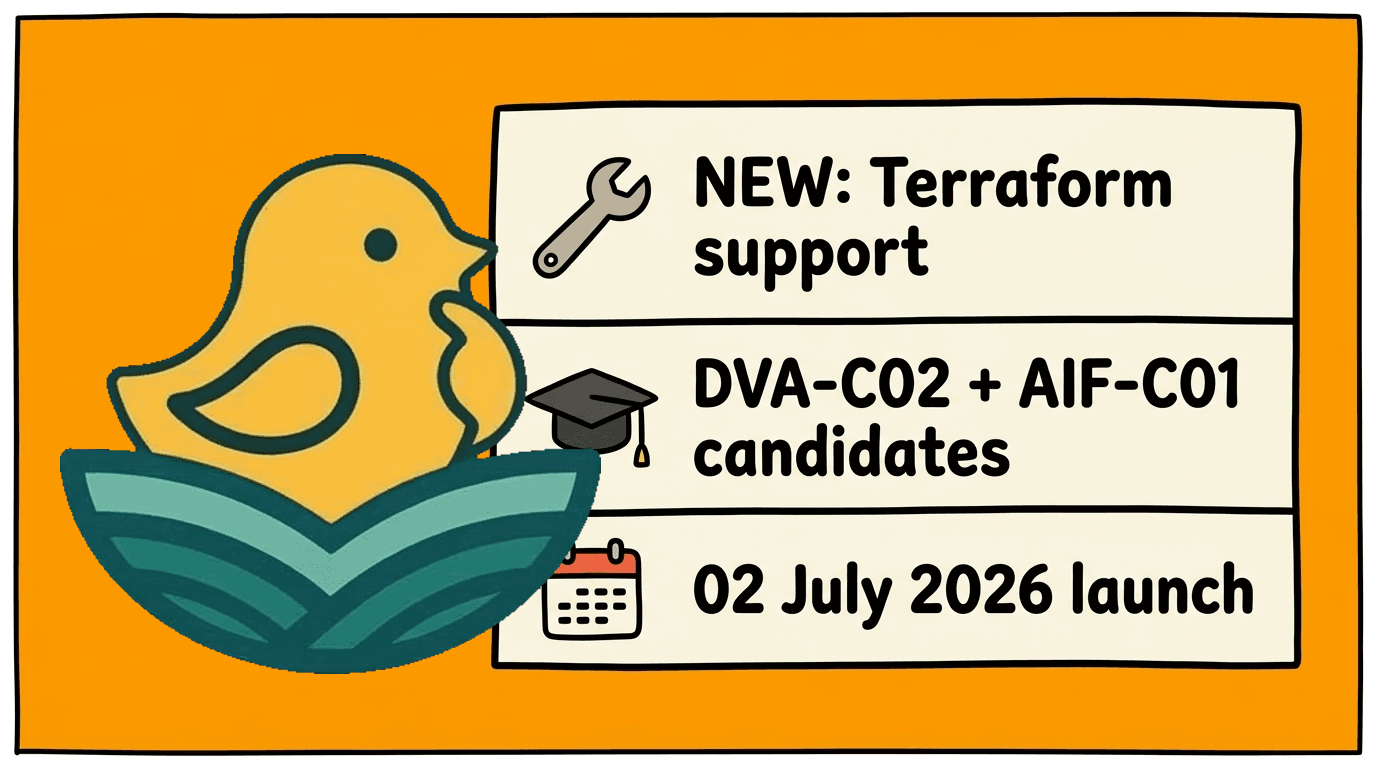
AWS just put Terraform inside SageMaker Unified Studio. Here is what that means for DVA-C02 and AIF-C01.
Reading is good. Practising is better.
Practice questions, flashcards and timed exams for 57 certifications. Start with a free starter pack — no card needed.