
I Studied SY0-701 for Three Months - Here Is What I Would Do Differently From Day One
Three months into studying for SY0-701, I realised I had spent the first six weeks doing almost exactly the wrong thing. The material was not too hard. The exam was not unfair. I had simply absorbed twelve hours of Professor Messer videos before touching a practice question, memorised every acronym in a vacuum, and assumed performance-based questions would be a small part of the exam. None of that was wrong - all of it was in the wrong order. After helping hundreds of people prep through ReadRoost, the same five mistakes show up in nearly every pass-second-time story I hear. Here is the version of day one I wish I had given myself.
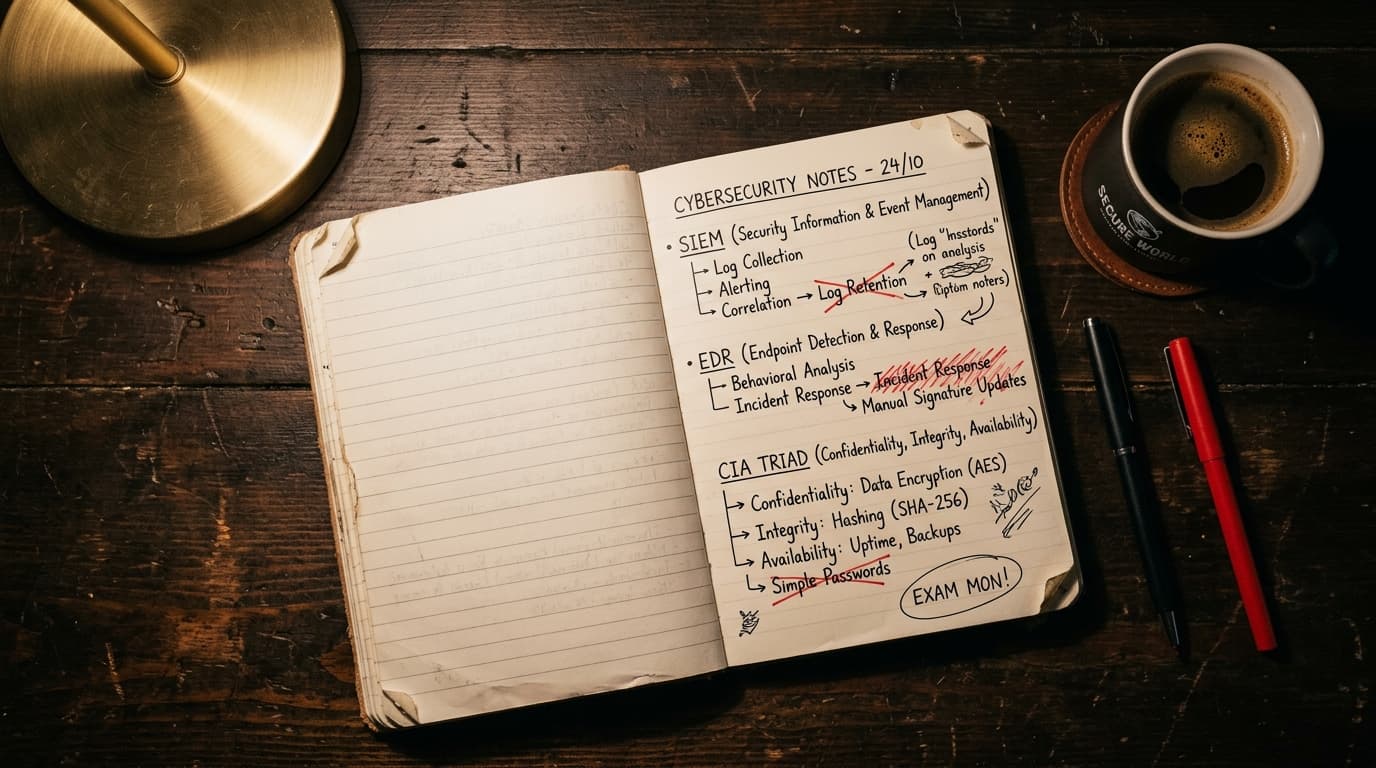
Mistake #1: Watching every Professor Messer video before touching a question
Professor Messer's free YouTube course is the best SY0-701 video resource that exists. It is also a trap if you treat it as the *whole* study plan. Most first-timers watch all 12 hours of it, feel like they understand the material, and then bomb their first practice exam in the 50s.
The fix is to front-load practice from week one, not week six. You learn Security+ by repeatedly seeing how concepts are tested, not by passively absorbing them. By the time you have watched all the videos without testing yourself, you have spent weeks reinforcing a passive recognition that the exam will not reward.
Watch a Professor Messer module, then do 20-30 ReadRoost questions covering that module the same day. Wrong answers tell you which sub-topic to rewatch. Right answers told you nothing - move on. This loop compounds. Pure video does not.
Mistake #2: Treating all five domains as equally weighted
SY0-701 has five domains, but they do not carry equal weight on the exam. General Security Concepts (12%) and Security Architecture (18%) dominate the question count, with Security Operations (28%) the single biggest domain. Together those three are over half the exam.
Threats, Vulnerabilities and Mitigations (22%) is where most career-changers spend the most time, because it is the most cybersecurity-flavoured material. The remaining Security Program Management and Oversight (20%) is governance, risk, and compliance language - dry, but high-yield because the questions are mostly definitional.
A balanced study plan respects these weights. Two hours on cloud security architectures returns more exam points than two hours memorising obscure attack-type names. Plan your weeks accordingly.
Mistake #3: Underestimating performance-based questions (PBQs)
PBQs are the interactive drag-and-drop and click-the-firewall-rule questions at the start of the exam. You typically see 3-5 of them, they carry weight, and they take 5-10 minutes each. Run out of time on the PBQs and you will rush the remaining 85+ multiple-choice questions.
Strategy: flag any PBQ you cannot solve in the first 60 seconds and come back to it. Get through the multiple-choice section first, banking confidence and time. Then return to the flagged PBQs with the time you have left. This single change is the difference between people who pass on the first attempt and people who run out of time.
Practice PBQs specifically. Reading about them is not enough - the muscle memory of the interactive interface matters. ReadRoost includes PBQ-style scenarios in our SY0-701 pack for exactly this reason.
Mistake #4: Studying acronyms in a vacuum
Security+ is dense with acronyms. CIA. RAID. SIEM. SOAR. EDR. XDR. NDR. MDR. DLP. CASB. SASE. ZTNA. The temptation is to make flashcards of every acronym and grind them in isolation.
This does not work because the exam never asks "what does CASB stand for". It asks "your company needs to enforce DLP across SaaS apps - which technology best fits". You have to know *what CASB does*, not just *what the letters mean*.
Study acronyms inside scenarios. ReadRoost flashcards pair the acronym with a one-sentence "when you would use it" - that pairing is what gets tested. Pure expansion (acronym → words) is a waste of your time.
Mistake #5: Buying too many resources
A lot of first-time test takers spend their first week shopping. They buy Jason Dion bundles, they buy Mike Chapple, they buy Sybex, they get the Andrew Ramdayal mind maps, they bookmark seven YouTube playlists. They end up with more material than they can possibly consume.
Pick two resources. One for learning. One for testing. That is it. A common combination that works for the majority of passers: Professor Messer (free) for video learning, and ReadRoost (or Dion practice exams) for question-based testing and weak-spot tracking. That is your entire study stack. Adding a third or a fourth resource does not increase your knowledge - it dilutes your study time across redundant material.
If you have more money than time, spend it on practice questions. If you have more time than money, double down on Professor Messer and squeeze every concept out of his free course. Either approach beats spending money on four overlapping textbooks.
The day-one plan in one paragraph
Week 1: Watch Professor Messer Domain 1 + do 30 ReadRoost questions per day on Domain 1. Week 2: Same loop for Domain 2. Week 3: Domain 3. Week 4: Domains 4 and 5. Week 5: Full-length practice exams under timed conditions, every second day. Review every wrong answer until you understand why the right answer is right. Week 6: Final 2-3 practice exams, plus PBQ-specific practice. Book the exam at the start of week 6. Take it at the end of week 6.
Six weeks. Two resources. Test from day one. Respect the domain weights. Practise PBQs deliberately. That is the plan I wish someone had handed me on the morning I started.
Why ReadRoost for SY0-701
ReadRoost's SY0-701 question pack ships 800+ questions covering every domain in the current exam version. Every question goes through our validation pipeline: Kimi K2 generates the question and explanation, Claude Opus reviews it against the official CompTIA exam objectives, and any unverifiable claim gets flagged and rewritten before publish.
Spaced repetition surfaces your weak domains automatically. The PBQ scenarios are included. The Improvement Guarantee means if you study with us and do not feel more confident on exam day, we refund - no argument.
Full Study Blueprint
See the complete crowdsourced blueprint with all 1 study plan for CompTIA Security+ — resources, ratings, and tips from people who passed.
Frequently Asked Questions
How long does SY0-701 take to study for if I am brand new to security?
If you have some general IT background (helpdesk, sysadmin, network admin), 6-8 weeks at 1-2 hours per day is the realistic window. Pure career-changers without IT exposure should plan for 10-12 weeks to build the foundational vocabulary first. Speed-running it in under 4 weeks works only for people who already do security-adjacent work day to day.
Is SY0-701 the current version, or is something new coming?
SY0-701 is the current version as of 2026 and is expected to remain the active exam for the foreseeable future. CompTIA typically refreshes Security+ every 3 years and the SY0-701 release was in late 2023. Treat it as stable - no replacement has been announced.
What score do I need to pass SY0-701?
The passing score is 750 out of 900. CompTIA does not publish a percentage equivalent, and the test is adaptive enough that the raw question count to hit 750 varies. Aiming for 80%+ on full-length practice exams under timed conditions is a reasonable proxy for being ready.
Should I do CompTIA Network+ before Security+?
Recommended but not required. Network+ helps if you do not yet have a strong grasp of TCP/IP, subnetting, and common protocols, because SY0-701 assumes that grounding and does not re-teach it. If you already have networking experience from work, you can skip Network+ and go straight to Security+.
Are PBQs really that hard?
They are not hard if you have practised them. They are very hard if you have only practised multiple-choice. The format is unfamiliar (drag-and-drop, configure-the-firewall-rule, match-the-attack-to-the-control) and the time pressure is real. Practice PBQs specifically in the last two weeks - do not save them for exam day.
AWS Microcredentials: the free, hands-on badge most people missed
Four AWS security services changed in a single week. Here is what SAA-C03 and SCS-C03 candidates need to know.
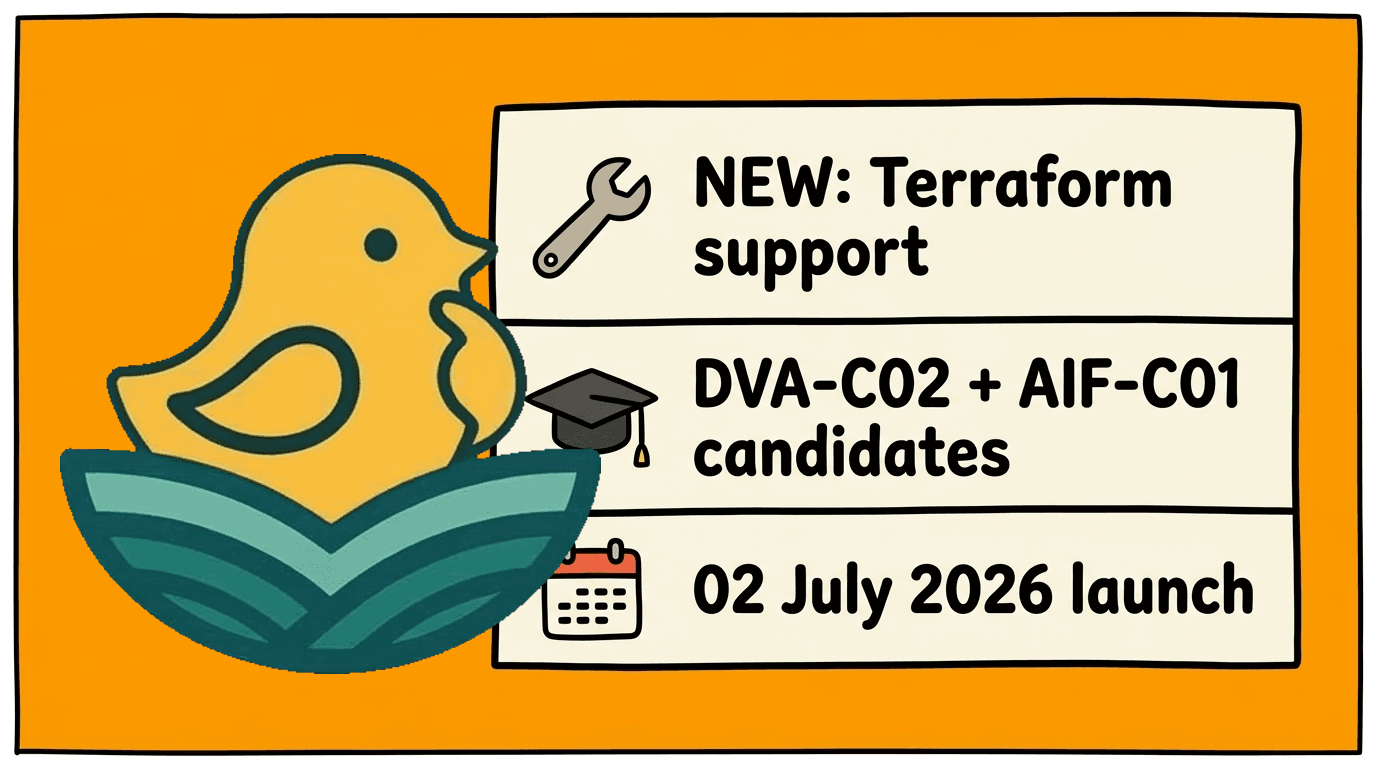
AWS just put Terraform inside SageMaker Unified Studio. Here is what that means for DVA-C02 and AIF-C01.
Reading is good. Practising is better.
Practice questions, flashcards and timed exams for 57 certifications. Start with a free starter pack — no card needed.