
AWS Microcredentials: the free, hands-on badge most people missed
Someone posted in r/AWSCertifications recently that they had just finished all five AWS Microcredentials, and most of the replies were not "nice work", they were "wait, what are those?". That is the gap worth closing. AWS Microcredentials launched quietly, they are free, they are hands-on in a way the exams are not, and a lot of people studying AWS still do not know they exist or where they fit. Here is the plain-English version: what they are, the ones live right now, and whether they are worth your time.
What an AWS Microcredential actually is
A microcredential is a timed, hands-on assessment. You get dropped into a real AWS console with a simulated business scenario and told to solve it: configure, troubleshoot, optimise, the same way you would on the job. There are no multiple-choice questions, no hints, and only minimal guidance. You can either build the thing or you cannot.
That is the whole point of them. A certification exam tests whether you know the concepts. A microcredential tests whether you can actually do the task in front of you. It is a different kind of proof, and for a lot of roles it is the more convincing one.
They are free, and that changes the maths
The part that surprises people: microcredentials do not cost anything to attempt. A full AWS certification exam runs from around 100 to 300 US dollars a sitting, so "is it worth it" is a real question with real money attached. With a microcredential the only thing you are spending is time.
That makes the decision much simpler. If a specific skill is relevant to where you are trying to go, and proving it costs you nothing but an afternoon, the bar for "worth it" is low.
The ones available right now
As of mid-2026 there are five live, and AWS has said more are on the way through the year. Treat this list as a snapshot, not a permanent record, because this space is moving quickly:
Serverless. Agentic AI, which now covers configuring and integrating Amazon Bedrock AgentCore, including its Runtime, Gateway and Memory features. Application Networking. Incident Response. And MLOps, built around using Amazon SageMaker AI to deploy and scale models.
The Agentic AI and MLOps ones are the most interesting if you are watching where the market is heading. They map onto exactly the work employers are starting to hire for, and because they are new, they are still uncrowded.
How they fit alongside certifications
They are not a replacement for certs, they are a complement. A certification is the broad, recognised credential that employers screen for and that shows up in job filters. A microcredential is a narrow, practical proof-point for one specific skill.
The clean mental model: certifications are the map, microcredentials are proof you have actually walked specific trails. If you already hold something like the Solutions Architect Associate and you want to show you can genuinely build serverless or handle an incident, a microcredential is a cheap, fast way to put that beyond doubt.
Who should bother, and who should wait
If you are brand new to AWS, these are not your starting point. They assume you can already navigate the console and know your way around the services, so a foundational cert like Cloud Practitioner comes first. Trying a hands-on assessment with no grounding is just a frustrating way to confirm you are not ready yet.
If you are an Associate or Professional with some spare study time and you want hands-on proof in a specific area, they are an easy win. And if you are trying to signal that you are current on the 2026 hot areas, the Agentic AI and MLOps microcredentials are worth grabbing while they are still new enough to stand out.
How to prepare for one
Because they are hands-on, passive study does not cut it. Watching a course or reading notes will not get you through a live-console assessment with no hints. The real preparation is time actually building the thing the microcredential is about, in a sandbox account, until the workflow is muscle memory.
ReadRoost is built for the knowledge layer underneath that: the AWS path where most people start and progress, from the foundational certs up through the associate and professional material, with questions that reflect the current AWS service set. Get the concepts solid here, put in the hands-on reps in the console, and a microcredential stops being a gamble and starts being a formality.
Frequently Asked Questions
Are AWS Microcredentials free?
Yes. Unlike the certification exams, which cost from roughly 100 to 300 US dollars a sitting, microcredentials are free to attempt.
Do microcredentials replace AWS certifications?
No. They complement them. A certification is the broad, recognised credential employers screen for; a microcredential is narrow, hands-on proof of one specific skill. Most people benefit from both, not one instead of the other.
Which AWS Microcredentials exist right now?
As of mid-2026 there are five: Serverless, Agentic AI, Application Networking, Incident Response, and MLOps. AWS has said more are coming through the year, so check the current AWS list before you plan around it.
Are they multiple choice like the exams?
No. A microcredential drops you into a live AWS console with a simulated scenario and asks you to actually build or fix something, with no multiple-choice questions and no hints.
Should a beginner start with a microcredential?
Not first. They assume you can already navigate the console, so start with a foundational cert like Cloud Practitioner, then come back to the hands-on assessments once you have the basics.
Four AWS security services changed in a single week. Here is what SAA-C03 and SCS-C03 candidates need to know.
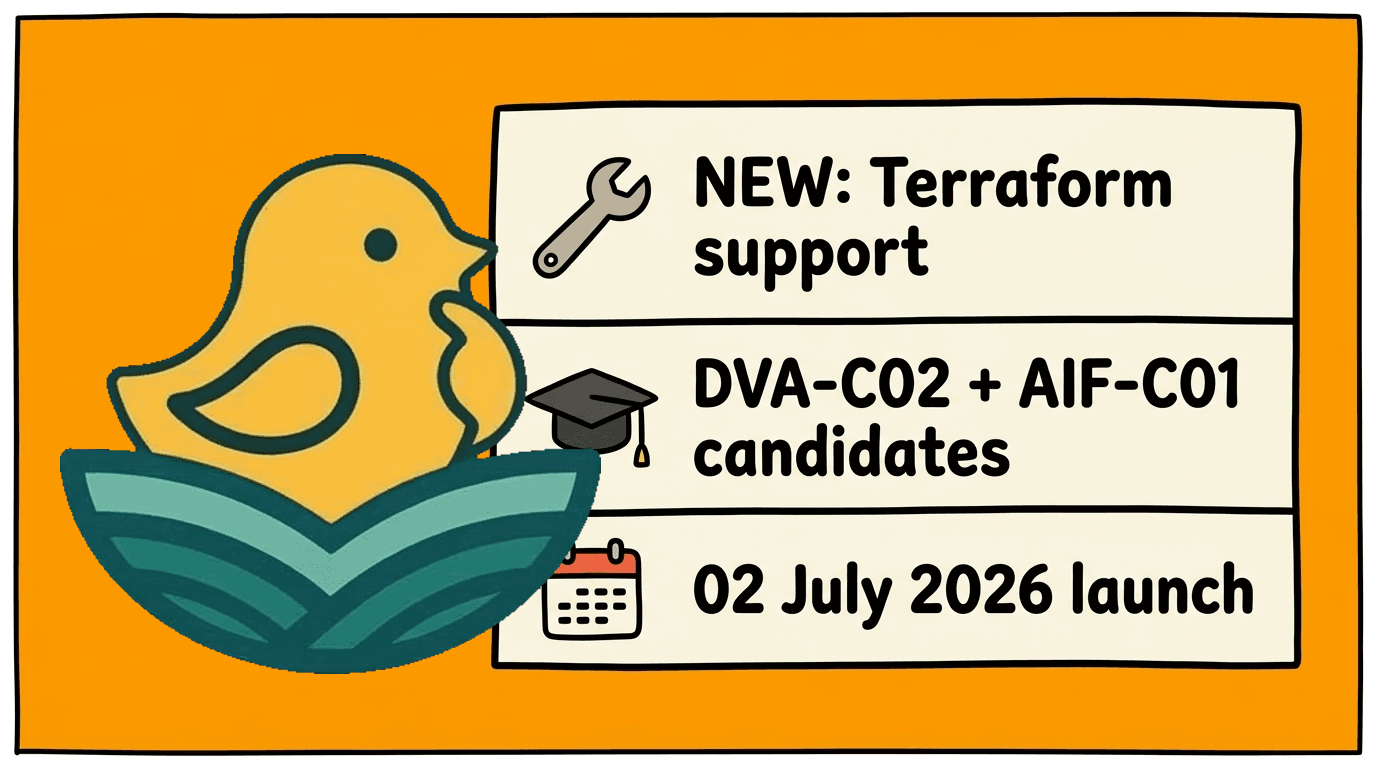
AWS just put Terraform inside SageMaker Unified Studio. Here is what that means for DVA-C02 and AIF-C01.

Why People Are Getting AWS Exams Voided at Home, and How to Make Sure You Are Not One of Them
Reading is good. Practising is better.
Practice questions, flashcards and timed exams for 57 certifications. Start with a free starter pack — no card needed.