
What Your Tutorial Dojo Score Actually Predicts for SAA-C03
Tutorial Dojo is the most-recommended SAA-C03 practice provider in any AWS subreddit, on Discord, and across Reddit's r/AWSCertifications. The reputation is earned - their bank is dense, their explanations are detailed, and the team behind it has been iterating on AWS content for years. Their published positioning is that their tests run roughly 10% harder than the real exam, which is why candidates scoring 72-76% on Tutorial Dojo can comfortably expect to pass the actual SAA-C03 (which needs 720/1000, or 72%). The math works. Right up until it does not. The threads where SAA-C03 candidates score 85%+ on Tutorial Dojo and then walk out of the exam shaken or marginally failing are not about Tutorial Dojo being wrong. They are about a specific failure mode that emerges precisely because Tutorial Dojo is so close to the real exam: candidates memorise the bank instead of learning the concepts, then AWS paraphrases its way past the memorisation. ReadRoost's free SAA-C03 pack is 509 scenario-based practice questions and 300 flashcards on a spaced-repetition schedule designed to drill concept-level reasoning rather than answer-pattern recall - the rest of this guide unpacks why that distinction matters more on SAA-C03 than on most other AWS exams.
Tutorial Dojo's SAA-C03 Reputation Is Earned
Let me say this clearly up front because the rest of the piece is going to be more critical: Tutorial Dojo's SAA-C03 practice exams are the best paid practice library on the market. Their reputation is not marketing. The question quality is high, the explanations teach the underlying concept (not just "the answer is C"), and the team has iterated on the content through SAA-C01, SAA-C02, and SAA-C03 with a feedback loop drawn from hundreds of thousands of test-takers. If you can only afford one paid SAA-C03 practice resource, Tutorial Dojo is the right one.
Their published claim is that the tests run roughly 10% harder than the real exam. That has been broadly accurate in the candidate feedback we see - somebody scoring 72-76% consistently on the Tutorial Dojo tests usually passes the real SAA-C03 comfortably. The 10% delta is the safety margin: prep against the harder version, and the real exam feels easier on the day. This is a genuinely good design choice and it is why the recommendation is so widespread.
The trap is not in the test design. The trap is in how candidates *use* the test bank. Specifically: in the difference between scoring well on Tutorial Dojo because you have learned the concept, and scoring well on Tutorial Dojo because you have seen the questions before.
The Paraphrase Trap (And Why SAA-C03 Specifically)
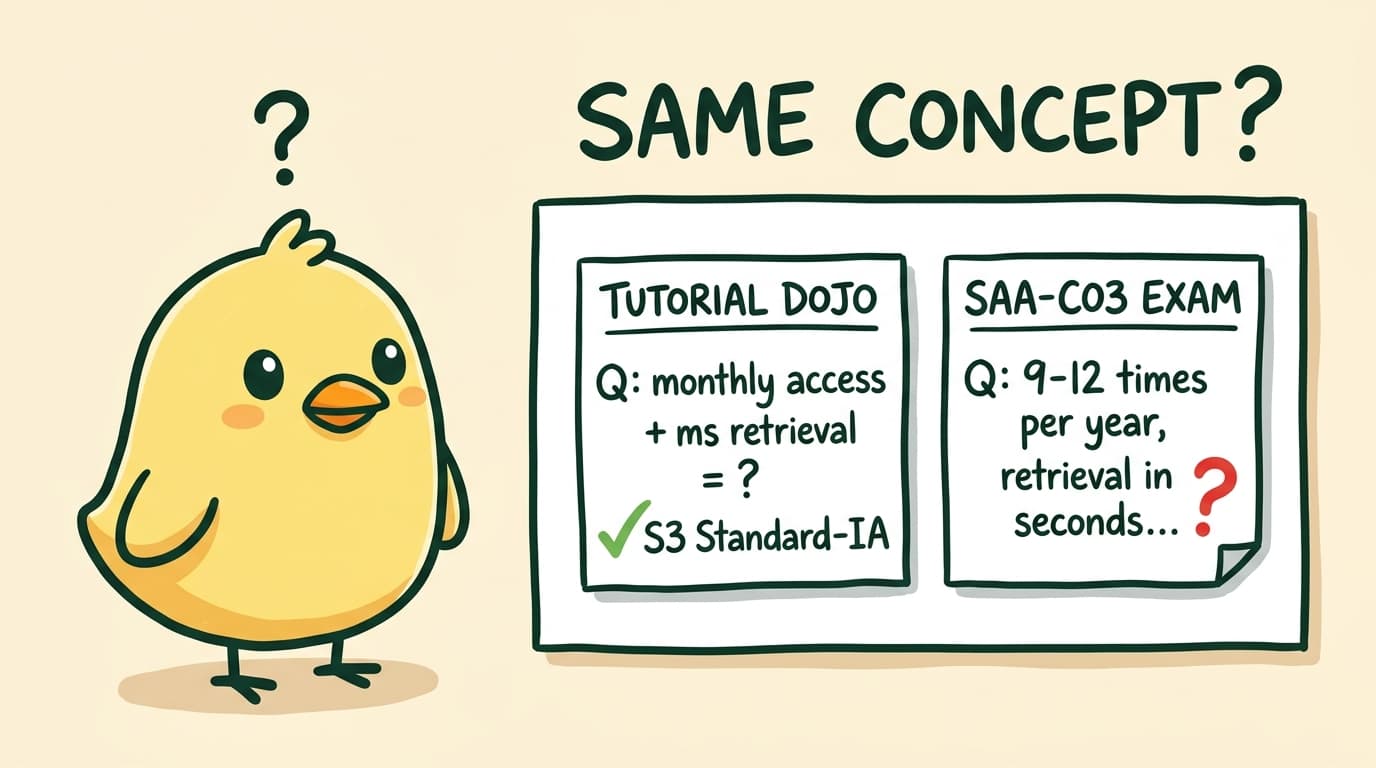
AWS publishes a finite pool of exam questions. So does Tutorial Dojo. The pools are not identical, but the underlying scenarios overlap heavily - because both are drawing from the same set of AWS service patterns and the same set of well-known architecture tradeoffs. When Tutorial Dojo writes a question about "choose the most cost-effective storage class for objects accessed monthly that need millisecond retrieval", they are writing a question about S3 Standard-IA. The same scenario exists in the AWS exam pool. The paraphrasing differs - the access frequency might be "infrequently accessed" or "reduced retrieval cost" or a specific dollar/month number that points the same way - but the underlying answer is the same.
The trap is that a candidate who drills the Tutorial Dojo bank enough times starts to recognise the surface pattern of each question. "Monthly access + millisecond retrieval = Standard-IA" becomes an automatic mapping. Their Tutorial Dojo score rises into the 85%+ range. They feel ready.
Then AWS sits them down and the same underlying scenario appears as: "A research team accesses archived experiment data about 9-12 times per year and needs the data available within seconds for ad-hoc analysis. The team currently uses S3 Standard but is looking to reduce costs while preserving retrieval performance." The question is the same concept. The wording is unrecognisable. The candidate who learned the *concept* picks Standard-IA in five seconds. The candidate who memorised the question patterns reads it twice, gets nervous, and either picks Glacier Instant Retrieval (close, but wrong on the retrieval-time guarantee) or freezes.
This is the SAA-C03 paraphrase trap. It is more dangerous on SAA-C03 than on most other AWS exams for two reasons. First, the SAA-C03 question pool leans heavily on scenario-based storage, networking, and cost-optimisation trade-offs where the concept space is narrow and the paraphrase space is wide - lots of ways to ask the same question. Second, Tutorial Dojo's bank is so close to the actual question style that candidates do not realise they are pattern-matching until the real exam reveals it.
What Your Tutorial Dojo Score Actually Predicts
Tutorial Dojo's claim is that scoring 72-76% on their tests predicts a comfortable pass. That claim is approximately correct *if* you are scoring 72-76% from concept-level reasoning rather than pattern recall.
The diagnostic is simple. On any Tutorial Dojo question you got right, can you explain *why* the right answer is right, what the wrong answers actually do (and the scenarios in which each wrong answer would be right), and what would happen if a single key variable in the scenario changed? If you can, you have learned the concept and your Tutorial Dojo score predicts the real exam. If you cannot - if you just "recognised" the answer - your Tutorial Dojo score predicts that you will fail the real exam by a margin that surprises you.
The candidates who score 85%+ on Tutorial Dojo and then narrowly fail the real exam are not unlucky. They have systematically drilled their pattern-recall muscle without proportional growth in their concept-reasoning muscle. The Tutorial Dojo number says they have practised; it does not say what they have practised.
The 10% delta in difficulty Tutorial Dojo advertises only protects you if your underlying reasoning is solid. If your underlying reasoning is shallow, no buffer protects you - because the real exam's paraphrase will land you outside your pattern-recognition zone in a way the practice tests never did.
Three Failure Modes Specific to SAA-C03 Tutorial Dojo Prep
Across years of r/AWSCertifications post-mortems, three specific failure modes recur.
Memorise the bank, fail the exam. The classic. Candidate drills the same six Tutorial Dojo timed practice tests through five or six iterations, score climbs from 60% to 90% as they remember the questions. They walk in confident. AWS paraphrases. They fail. The fix is simple but counter-intuitive: do not re-take the same Tutorial Dojo tests more than twice. After two passes, you are memorising. Drill the questions you got wrong individually, then move to a different question source for further practice.
Under-confidence from low practice scores. Tutorial Dojo's 10%-harder positioning means a first pass through their tests often scores in the 55-65% range. Candidates panic, postpone the exam, and end up over-preparing for months. The Tutorial Dojo 10% buffer is exactly why a 60% on the practice tests still predicts a comfortable pass on the real exam if your reasoning is solid. Postponing while your reasoning is solid wastes weeks.
Skipping hands-on AWS time because the question bank feels exhaustive. The Tutorial Dojo library is so thorough that candidates feel like they are learning AWS by drilling it. That is partly true (the concepts are there) and partly an illusion (the actual fingertip-familiarity with the console, the CLI, and IAM JSON is not). Candidates who skip hands-on time get the questions right in practice and then freeze in the rare real-exam item that asks about ARN formats or specific CLI argument order. The cure is 6-10 hours in an AWS free-tier account, structured around the SAA-C03 domains.
The Four Gaps to Close Before SAA-C03 Exam Day
Working from a solid Tutorial Dojo baseline, here is what to add to close the gap that the practice tests alone leave open.
Gap 1: Concept-level review, not just answer-checking. On every Tutorial Dojo question, force yourself to articulate the underlying concept before checking the explanation. If the question is about VPC peering, the concept is "non-transitive, no overlapping CIDRs, intra-region or inter-region but always same-tenancy." Knowing that the answer is "VPC peering" is not the same as knowing the concept. Spend 30 seconds per question on this even when you got the answer right. It is the single biggest habit in the entire SAA-C03 prep cycle.
Gap 2: A second question source. Once you have done two full passes through Tutorial Dojo, switch to a second provider for 30-40% of your remaining practice. ReadRoost's free SAA-C03 pack at readroo.st/marketplace/aws-saa-c03-solutions-architect is 509 scenario-based questions with explanations, scheduled on a spaced-repetition algorithm. Different question authors means different paraphrasings of the same concepts, which is exactly the pattern-breaking you want. The official AWS Skill Builder also has scenario sets worth doing.
Gap 3: 6-10 hours of hands-on AWS in a free-tier account. Build a VPC with public and private subnets, an EC2 instance, an ALB, an Auto Scaling Group, an RDS instance, an S3 bucket with lifecycle policies, an IAM role attached to the EC2 instance with a policy that lets it read the bucket. Break it. Fix it. Read the CloudTrail events. The point is not the lab itself - it is to know what the AWS console actually looks like under your fingers, so the real-exam questions that reference specific service screens or behaviours feel like home.
Gap 4: One full-length timed exam in week minus one. 65 questions in 130 minutes (the SAA-C03 format). No pauses, no lookups, no breaks. Use Tutorial Dojo's full mode if you have not exhausted those, or use ReadRoost's full-length practice for a fresh question set. The point is the pacing rehearsal: you need to know what 2 minutes per question feels like before the real exam clock starts. Most candidates over-spend on the first 15 questions because they read carefully, then panic-rush the final 20.
How ReadRoost Complements Tutorial Dojo (We Are Honest)
We make AWS SAA-C03 practice content. So this is the part where we are honest about what we do, what we do not, and where we fit relative to Tutorial Dojo.
What ReadRoost does that Tutorial Dojo does not: spaced repetition by default. The same 509 questions in our SAA-C03 pack come back at the intervals you are about to forget them (1 day, 3 days, 7 days, 14, 28+), so the concept stays sharp across the entire prep cycle rather than peaking the week of the exam and then decaying through your three-year recert window. Plus 300 flashcards on the same spacing schedule, useful for the AWS service taxonomy that has to be in long-term memory rather than short-term cram.
What ReadRoost does *not* do better than Tutorial Dojo: replicate the exam-question shape with the same fidelity Tutorial Dojo has earned through years of iteration. Their questions are closer to the actual exam pool than ours, and we will not pretend otherwise. Use ours for the spacing-driven daily practice and the concept-level reasoning drill; use theirs for the realistic-shape pattern exposure. The two together cover what either alone misses.
What ReadRoost does *not* replace: the hands-on AWS time. SRS holds conceptual recall. It does not, on its own, keep your fingers familiar with the AWS console or the CLI. Free-tier account, 6-10 hours, week before the exam.
The whole ReadRoost AWS catalog is free, including the SAA-C03 pack, no paywall. We are positioning ReadRoost as the complement to Tutorial Dojo, not the replacement.
The Seven-Day Pre-Exam Checklist
Inside the final week before your SAA-C03 sitting, here is the order of operations that actually closes the gap on exam day.
Day -7: Sit one full-length timed practice from a source you have not already drilled (Tutorial Dojo if you have only used another provider; ReadRoost if you have only used Tutorial Dojo). 130 minutes, no pauses. Score it. Identify the domains where you scored worst.
Day -6 and -5: Drill the weakest two domains using concept-articulation as the discipline. For every question - right or wrong - state the underlying concept before reading the explanation. Read every explanation in full.
Day -4: Hands-on AWS day. Spend 3 hours in your free-tier account building one full end-to-end scenario - VPC, EC2 behind ALB, ASG, RDS Multi-AZ, S3 with lifecycle, IAM role. Run it. Document what you did. Take screenshots.
Day -3: Service-taxonomy flashcard drill. Run through every AWS service in scope for SAA-C03 and articulate, in one sentence, what each does and when you would choose it over an alternative. This is the gap that gets exposed on the "name the service" type items.
Day -2: Read the AWS SAA-C03 exam guide front to back. The official one from the AWS website. Note any service or feature you do not instantly know the purpose of - those go on the day-1 review list.
Day -1: Light review only. Re-read your weakest domain and the day-2 list. Do not sit a full practice. Sleep properly. The marginal point from one more practice exam is not worth the cognitive fatigue.
Day 0: Show up early, hydrate, read each question twice before choosing an answer, and mark-and-move on any single question taking more than 100 seconds. Trust the prep. Pacing is the only variable left to control.
Why the Pattern Will Persist
Tutorial Dojo is not going to get worse, and AWS is not going to make its question paraphrasing easier. The paraphrase trap will keep claiming candidates because the underlying mechanism is structural: any practice library that is close enough to the real exam to be useful is also close enough to be memorisable, and memorisation is what happens when humans drill the same content repeatedly without deliberate concept articulation.
The defence is not to use a worse practice library. It is to use the good one well. Drill once. Drill again. After that, switch sources, articulate concepts, get hands-on, and rehearse pacing. The candidates writing the "passed first try, 850/1000" posts in r/AWSCertifications are not the ones who memorised the most Tutorial Dojo questions. They are the ones who could explain *why* each question's answer was the answer, in their own words, before they ever saw the explanation.
Tutorial Dojo predicts your SAA-C03 outcome accurately. The prediction just runs through your concept-reasoning, not your pattern-recall. Build the reasoning; let the score follow.
Full Study Blueprint
See the complete crowdsourced blueprint with all 1 study plan for AWS Certified Solutions Architect Associate — resources, ratings, and tips from people who passed.
Frequently Asked Questions
How accurate is Tutorial Dojo's '10% harder' claim for SAA-C03?
Broadly accurate based on candidate feedback. The Tutorial Dojo tests run roughly 10% harder than the real SAA-C03, which is why scoring 72-76% on their practice tests usually predicts a comfortable pass on the real exam (which needs 720/1000, or 72%). The accuracy depends on whether your high practice score reflects concept understanding or memorisation of the question bank from repeated drilling.
What percentage on Tutorial Dojo SAA-C03 means I am ready?
Tutorial Dojo's own positioning is that 72-76% predicts a comfortable pass, accounting for their 10% difficulty buffer. The honest threshold: if you are scoring 72-76%+ and you can explain *why* each correct answer is correct (in your own words, before checking the explanation), you are ready. If you are scoring 85%+ but recognise the questions from prior drilling, your score is inflated by memorisation and the real exam will surprise you.
Is Tutorial Dojo enough to pass SAA-C03 on its own?
For candidates with existing AWS work experience, yes - Tutorial Dojo plus the AWS exam guide will get most working AWS engineers through. For candidates studying SAA-C03 as a first or near-first AWS cert, pair Tutorial Dojo with a second question source (ReadRoost, AWS Skill Builder), 6-10 hours of hands-on AWS time in a free-tier account, and at least one full-length timed practice exam.
Why do high Tutorial Dojo scorers still fail SAA-C03 sometimes?
The most common reason is the paraphrase trap: drilling the same Tutorial Dojo bank through multiple iterations causes candidates to memorise the question patterns rather than the underlying AWS concepts. The real SAA-C03 exam paraphrases scenarios, so memorised pattern-recognition breaks down on questions that test the same concept worded differently. The fix is to articulate the concept before checking each answer and to use a second question source to avoid pattern lock-in.
How many questions are on the real SAA-C03 exam?
65 questions in 130 minutes, plus 15 unscored questions that AWS uses for future-exam development (not identified during the test). Passing is 720 on a scaled score of 100-1,000. Question types are multiple-choice and multiple-response.
Can I use Tutorial Dojo and ReadRoost together for SAA-C03?
Yes, this is the recommended combination. Tutorial Dojo gives you exam-shape pattern exposure against a large, mature library. ReadRoost's free SAA-C03 pack adds 509 scenario-based questions and 300 flashcards on a spaced-repetition schedule, designed to drill concept-level reasoning rather than pattern recognition. Together they cover the gap either alone leaves: Tutorial Dojo for realistic-shape exposure, ReadRoost for daily-practice retention.
How long should I study for SAA-C03 in 2026?
Most candidates who pass on the first attempt report 6-12 weeks of part-time study from a working IT or junior AWS background. Pure beginners with no cloud experience should plan 16-20 weeks and sit AWS CLF-C02 (Cloud Practitioner) first. Existing IT pros with non-AWS cloud experience usually need 4-6 weeks. Plan the booking so the exam date is roughly 7 days after your first full-length, timed practice run.

AWS Microcredentials: the free, hands-on badge most people missed
Four AWS security services changed in a single week. Here is what SAA-C03 and SCS-C03 candidates need to know.
AWS just put Terraform inside SageMaker Unified Studio. Here is what that means for DVA-C02 and AIF-C01.
Reading is good. Practising is better.
Practice questions, flashcards and timed exams for 57 certifications. Start with a free starter pack — no card needed.