
Why 80% on Tutorial Dojo Doesn't Mean You'll Pass AZ-104
If you have been scoring 80%+ on Tutorial Dojo's AZ-104 practice exam and feeling good about exam day, the r/AzureCertification threads this month should slow you down. The pattern is consistent enough that it is worth saying out loud: Tutorial Dojo is excellent practice, but practicing the recognition-level shape of AZ-104 questions is not the same as being ready for the real assessment. The gap is real, it is widening, and Microsoft refreshed the AZ-104 catalogue on April 17, 2026 with new emphasis on hybrid cloud, Microsoft Entra ID, Azure Arc, and AI services - which means some of the practice content people are leaning on is targeting the previous shape of the exam. ReadRoost's free AZ-104 pack is 600 scenario-based practice questions and 350 flashcards aligned to the current April 2026 blueprint - the rest of this guide explains what Tutorial Dojo is doing well, what it leaves on the table, and the four gaps you need to close before exam day.
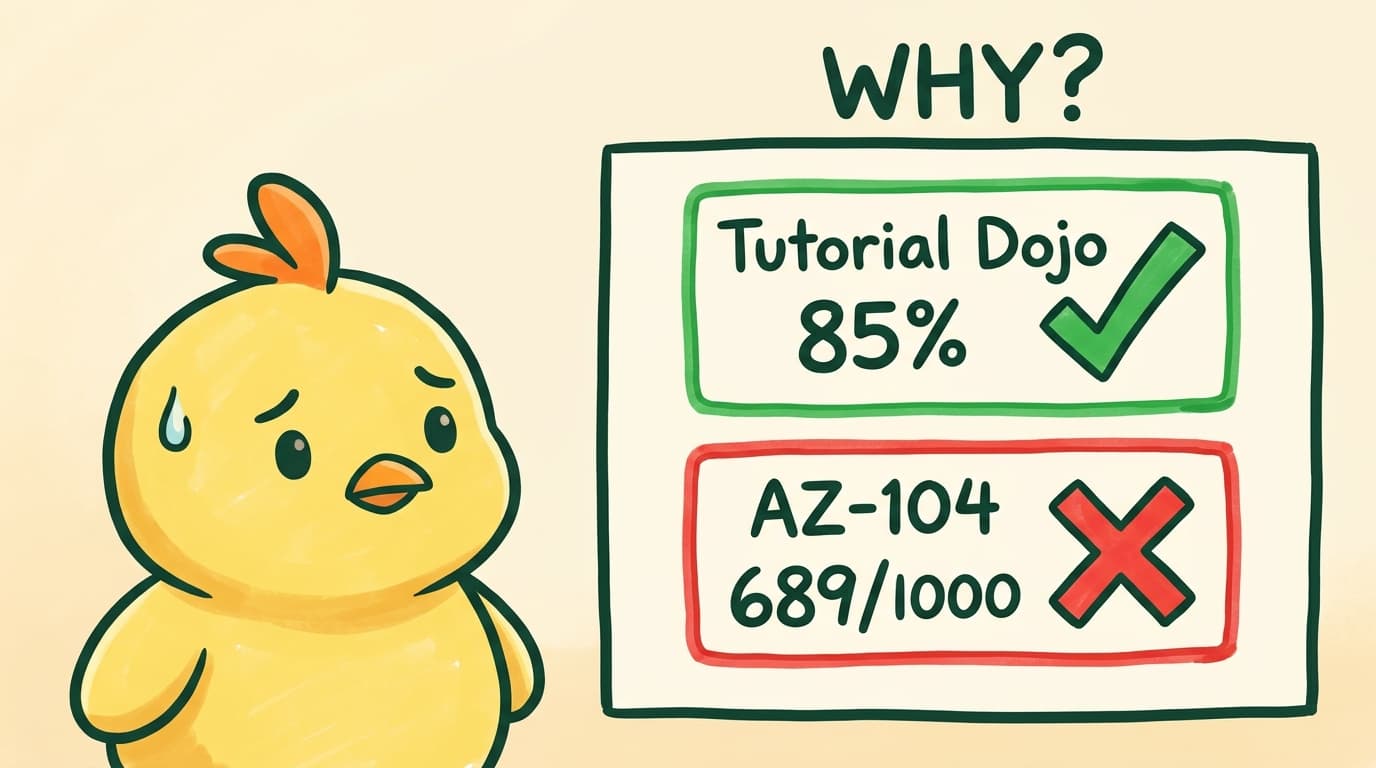
The Pattern: 80% on Practice, Walking Out Shaken
Scroll r/AzureCertification on any given week in May 2026 and the same shape of post appears: candidate studies hard for six to ten weeks, hits 80% or higher on the Tutorial Dojo practice exam, walks into the real AZ-104, and either fails by a thin margin or passes and describes it as luckier than they were comfortable with. The numbers in their write-ups vary, the tone does not. The exam felt harder, less predictable, and oddly different from what their practice library trained them on.
The instinctive read is that Tutorial Dojo's questions are too easy. That is not the failure mode. Tutorial Dojo is a high-quality library that mostly mirrors the question patterns Microsoft has historically used, and a strong score there is a real signal of solid recognition-level knowledge. The failure mode is what Tutorial Dojo cannot test, on top of a catalogue that has just shifted.
Two things are happening at once. First, the AZ-104 exam was refreshed on 17 April 2026 - Microsoft kept the five-domain structure but rebalanced weights and added emphasis on hybrid cloud management, AI service integration, Microsoft Entra ID, and Azure Arc. Practice content that was written before the refresh under-weights some of what the real exam now leans on. Second, even with the most current question library, the shape of a real Microsoft assessment includes case studies and practical scenarios that no static multiple-choice bank can fully reproduce.
What Tutorial Dojo Is Actually Testing
Be fair to Tutorial Dojo. It is doing what a question bank can do, and doing it well: drilling the recognition-level surface area of AZ-104. You see a scenario, you pick the service or setting, you check the explanation, you move on. Repeated enough times, the right answers become automatic and the wrong distractors get filtered out. That is not nothing - it is the foundation everything else sits on.
What you build with Tutorial Dojo: solid recall of the Azure service taxonomy, comfort with the multiple-choice question format Microsoft uses on the bulk of the exam, fluency with common scenarios (VM resizing, NSG troubleshooting, storage tier selection, Entra ID role assignment), and a calibrated sense for which distractors are designed to trap you. People who score 80%+ on Tutorial Dojo are genuinely strong on those things. The score is not a lie.
What it is not telling you: whether you can sustain that performance under 100 minutes of real-time pressure, whether you can navigate a multi-step case study with imperfect information, whether you have actually touched the services you are answering questions about, and whether the question shape on your specific exam day matches the shape the library was trained on.
What Tutorial Dojo Is Not Testing (And Where the Gap Hides)
Four areas the static multiple-choice format simply cannot reach.
Case studies and multi-step scenarios. The real AZ-104 includes case-study items: a scenario document you read in full, then several connected questions you answer using the same context. The skill being tested is not recognition - it is integrating information across requirements, constraints, and current-state details to pick an answer that is right for this environment, not right in the abstract. Tutorial Dojo's individual-question format trains the wrong muscle for this. Candidates who have never sat a case-study practice run lose meaningful points here.
Practical and lab-shaped questions. The April 2026 refresh kept practical and case-study items in the format mix. These ask you to do something - configure, troubleshoot, sequence steps - rather than recognise an answer. People who studied entirely from question banks frequently report freezing on practical items, because the cognitive shape is different. The fix is hands-on time in a real Azure tenant, not more multiple choice.
The April 2026 catalogue shifts. Hybrid cloud (Azure Arc, Azure Stack), AI service integration, and Microsoft Entra ID got more weight in the refresh. Container Apps appeared as a focus. Cost optimisation and automation (CLI, PowerShell, ARM templates, Bicep) are emphasised more explicitly. If your Tutorial Dojo subscription was bought before April 2026 and has not been refreshed, your practice mix is leaning on the old weights. Verify your provider has updated, or supplement.
Time pressure across 40-60 questions in 100 minutes. Most people study in five or ten-question chunks with no time pressure, then sit a 100-minute exam where one slow case-study can eat fifteen of those minutes. The skill of pacing - knowing when to mark and move - has to be practiced separately. A practice library tested untimed is not exercising it.
The Four Gaps You Need to Close Before Exam Day
Working from a solid Tutorial Dojo baseline, here is what to add. These are the gaps that explain the failed-with-689 and passed-with-741 stories you keep reading.
Gap 1: Hands-on Azure time, not just question bank time. Spin up a free Azure tenant (the free tier covers most AZ-104 services for the relevant exam window). Walk through the Microsoft Learn AZ-104 modules in the portal, not just on paper. Build a virtual network, attach an NSG, deploy a VM, configure a storage account with lifecycle rules, hook up monitoring, restore from backup. The point is not to memorise the steps - it is to know what the portal looks like under your fingers, so the practical-flavoured questions on exam day feel like home.
Gap 2: At least one full-length, timed, case-study run. Microsoft's own MeasureUp practice test (the official partner) includes the case-study format. Sit one full-length untimed first to learn the structure, then sit one timed to learn the pacing. Most people only do this in the final week, and most people regret not doing it earlier.
Gap 3: Verify your practice content reflects the April 17, 2026 refresh. Check your Tutorial Dojo (or whichever provider you use) for an explicit note about the April 2026 update. If your provider has not updated, supplement with the Microsoft Learn AZ-104 study guide (updated within days of the refresh) and prioritise the Entra ID, Azure Arc, Container Apps, and cost-optimisation modules. ReadRoost's free AZ-104 pack at readroo.st/marketplace/az-104-azure-administrator is aligned to the current blueprint - 600 scenario-based questions and 350 flashcards across the five live domains with current weights.
Gap 4: A pacing rehearsal in week one before exam week. Set a timer to 100 minutes, work a 40-question simulated exam, and stop when the timer ends. Score whatever you finished. The point is not the score - it is calibrating how long you actually spend on a tricky question before moving on. You will be surprised. Most people overspend on item three and underspend on item thirty.
How ReadRoost Fits in (And Where We Are Honest About Limits)
We are an AZ-104 prep provider, so this is the part where we are honest about what we do and what we do not. The ReadRoost AZ-104 pack is 600 practice questions and 350 flashcards, aligned to the April 2026 blueprint, with scenario-based item writing rather than pure recognition recall. It is free to use - the whole pack, with explanations, no paywall.
The thing ReadRoost adds that a static question bank does not: spaced repetition. The same fifty AZ-104 concepts come back at the intervals at which you are about to forget them, so the recall stays sharp through the eight or twelve weeks of prep rather than fading at week six. That is the difference between memorising a fact and owning it. The mechanism is the same Anki and Duolingo built their reputations on, ported into a cert-prep context.
What ReadRoost does not replace: the hands-on Azure time, the case-study format rehearsal, or the timed pacing run. Those gaps need real Azure time and the case-study practice MeasureUp offers (or the Microsoft Learn case-study labs - they are free). Use ReadRoost as your daily-practice engine, use Azure for the lab work, and use a case-study practice once or twice for the format rehearsal. That is the full kit.
The Seven-Day Pre-Exam Checklist
If you have done the above and you are inside the final week, here is the order of operations that closes the gap on exam day.
Day -7: Sit one full-length timed practice from any provider (Tutorial Dojo, MeasureUp, ReadRoost). 100 minutes, no pauses, no looking things up. Score it. The categories you scored worst on become this week's focus.
Day -6 and -5: Drill the weakest two domains using your preferred question bank. Read each explanation in full, even on questions you got right - the explanations are where the depth lives.
Day -4: Hands-on Azure day. Spend two to three hours in your free tenant rebuilding one full scenario end-to-end - a VM behind a load balancer in a VNet with an NSG and storage backing. Run it. Break it. Fix it.
Day -3: Case-study format rehearsal. Find one case-study practice (MeasureUp has them, the Microsoft Learn AZ-104 module has scenario labs) and sit it untimed. Read the scenario in full before touching the questions.
Day -2: Read the Microsoft Learn AZ-104 study guide front to back - the most recent version published after 17 April 2026. Note any service or feature you do not instantly know the purpose of.
Day -1: Light review only. Re-read your weakest domain. Do not sit a full practice. Sleep properly. The marginal point from one more 50-question grind is not worth the cognitive fatigue.
Day 0: Show up early, hydrate, read each case-study scenario twice before touching the questions, and mark-and-move on any single question taking more than 90 seconds. Trust the prep. The pacing is the only variable left to control.
Why This Pattern Will Get Worse Before It Gets Better
The Tutorial-Dojo-said-I-would-pass-and-the-real-exam-said-no pattern is not new, but it is sharper in 2026 for two reasons. First, Microsoft is refreshing certification content faster than the third-party provider ecosystem can match - the April 2026 AZ-104 refresh is the third meaningful update inside eighteen months. Providers that update slowly are systematically training people on stale weights. Second, the cert prep market has consolidated around a handful of large providers, and the candidate base assumes any one of them is sufficient. Five years ago a serious candidate used three providers and Microsoft Learn. Today many use one provider and the official study guide if they are conscientious.
The fix is not to abandon Tutorial Dojo or any other strong provider. It is to recognise where the format ends and to supplement it deliberately: hands-on Azure time, one case-study rehearsal, current-blueprint coverage, and a single timed pacing run. People who do those four things in addition to a practice bank are the ones writing the 'passed on first try' posts in r/AzureCertification. People who skip them are the ones writing the 'failed with 689' posts.
Tutorial Dojo did not lie to you. It just was not asked to tell you the rest of the story.
Full Study Blueprint
See the complete crowdsourced blueprint with all 1 study plan for Microsoft Azure Administrator — resources, ratings, and tips from people who passed.
Frequently Asked Questions
Is Tutorial Dojo enough to pass AZ-104 on its own?
For some candidates with existing Azure experience, yes. For most candidates studying AZ-104 as a first or second Microsoft cert, no. Tutorial Dojo is excellent recognition-level practice but it does not rehearse the case-study format, hands-on Azure work, or the post-April 2026 catalogue weights. Pair it with at least one MeasureUp or ReadRoost full-length timed run plus 8-12 hours of hands-on Azure tenant time.
What percentage on Tutorial Dojo means I am ready for AZ-104?
There is no clean threshold. People have failed at 85%+ averages and passed at 75% averages. A more honest readiness signal is whether you can pass a timed, full-length, case-study-inclusive practice run from any provider while staying inside the 100-minute window. If you can do that and you have done at least 8 hours of hands-on Azure work in the last 4 weeks, you are exam-ready regardless of your raw Tutorial Dojo percentage.
How is the real AZ-104 different from Tutorial Dojo's practice questions?
Three differences. First, the real exam includes case-study items where multiple questions share a scenario document - the cognitive shape is integration, not recognition. Second, it includes practical and lab-shaped items asking you to sequence or configure rather than identify. Third, the April 17, 2026 refresh shifted weights toward Microsoft Entra ID, Azure Arc, Container Apps, AI service integration, and hybrid cloud - if your practice content predates that refresh, your weights are off.
Did the AZ-104 exam change in 2026?
Yes. Microsoft published a meaningful catalogue refresh on 17 April 2026. The five-domain structure was retained but weights were adjusted and new emphasis was added around hybrid cloud management, AI service integration, Microsoft Entra ID, Azure Arc, Container Apps, and cost optimisation with CLI, PowerShell, ARM templates, and Bicep. Practice content from before April 2026 leans on the previous weights and is incomplete on the new focus areas.
What are the best free hands-on labs for AZ-104 preparation?
The Microsoft Learn AZ-104 learning path includes interactive sandbox labs that run inside the portal at no cost - those are the highest-yield free option because they target the exam blueprint directly. The Azure free tier covers most AZ-104 services for a sufficient window to build the practical scenarios you need. Cloud Skills Challenge events (Microsoft runs these periodically) give time-limited free access to additional labs and a community to ask questions in.
Can I use Tutorial Dojo and ReadRoost together?
Yes, and it works well. They serve different purposes. Tutorial Dojo gives you exam-shape multiple-choice drilling against a large question library. ReadRoost's AZ-104 pack adds 600 scenario-based questions and 350 flashcards on a spaced-repetition schedule so the right concepts come back at the intervals you are about to forget them - which holds recall through long study cycles. Many candidates use one as the daily-practice engine and the other for full-length practice exams.
How long should I study for AZ-104 in 2026?
Most candidates who pass on the first attempt report 6-10 weeks of part-time study (8-12 hours per week) from an existing baseline of basic cloud familiarity. Pure beginners with no IT background should plan 12-16 weeks and sit AZ-900 first. Existing IT pros with non-Azure cloud experience usually need 4-6 weeks. Time the exam booking so it is roughly 7 days after you sit your first full-length, timed, case-study-inclusive practice run.
AWS Microcredentials: the free, hands-on badge most people missed
Four AWS security services changed in a single week. Here is what SAA-C03 and SCS-C03 candidates need to know.
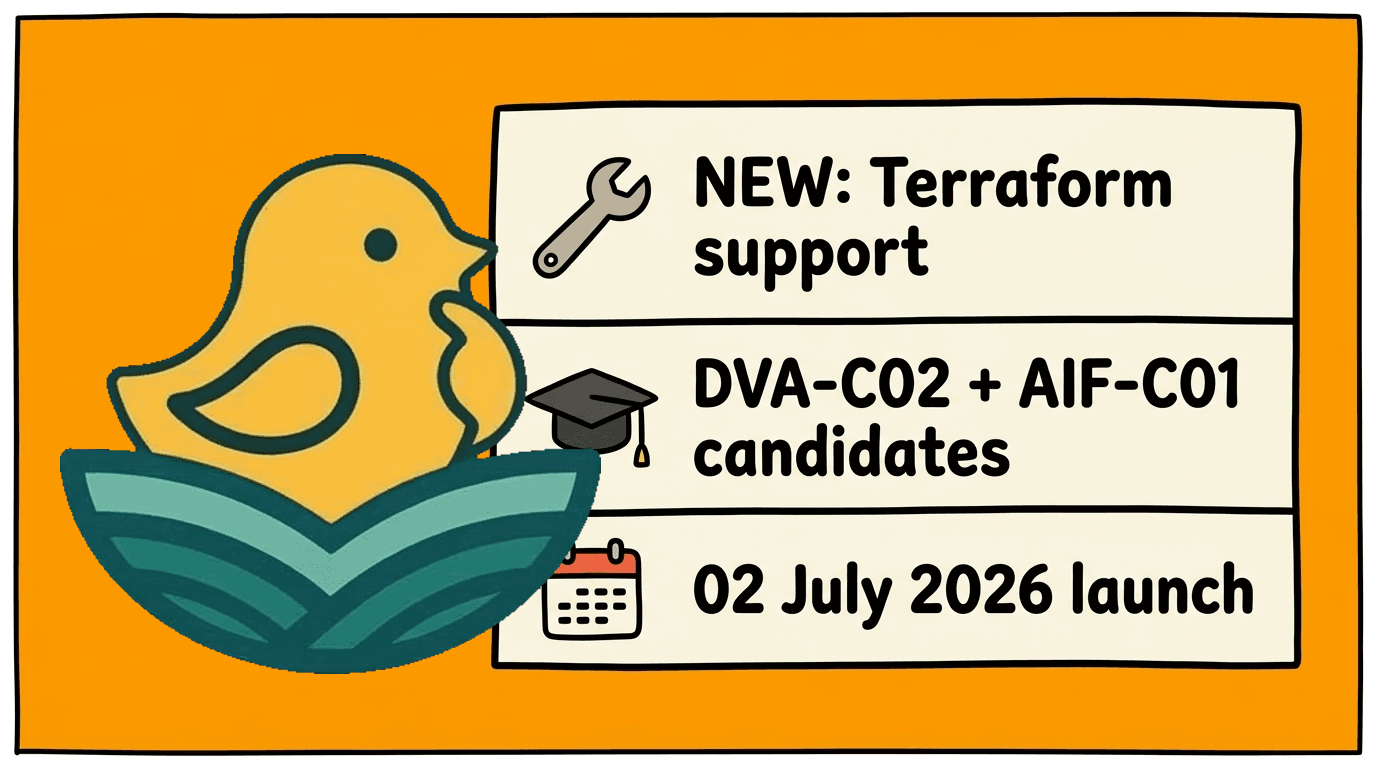
AWS just put Terraform inside SageMaker Unified Studio. Here is what that means for DVA-C02 and AIF-C01.
Reading is good. Practising is better.
Practice questions, flashcards and timed exams for 57 certifications. Start with a free starter pack — no card needed.