Skip to content
Security+ or CySA+ first? The job ads disagree with the study subs.
comparison

Security+ or CySA+ first? The job ads disagree with the study subs.

By ReadRoost Teamโ€ขJune 7, 2026
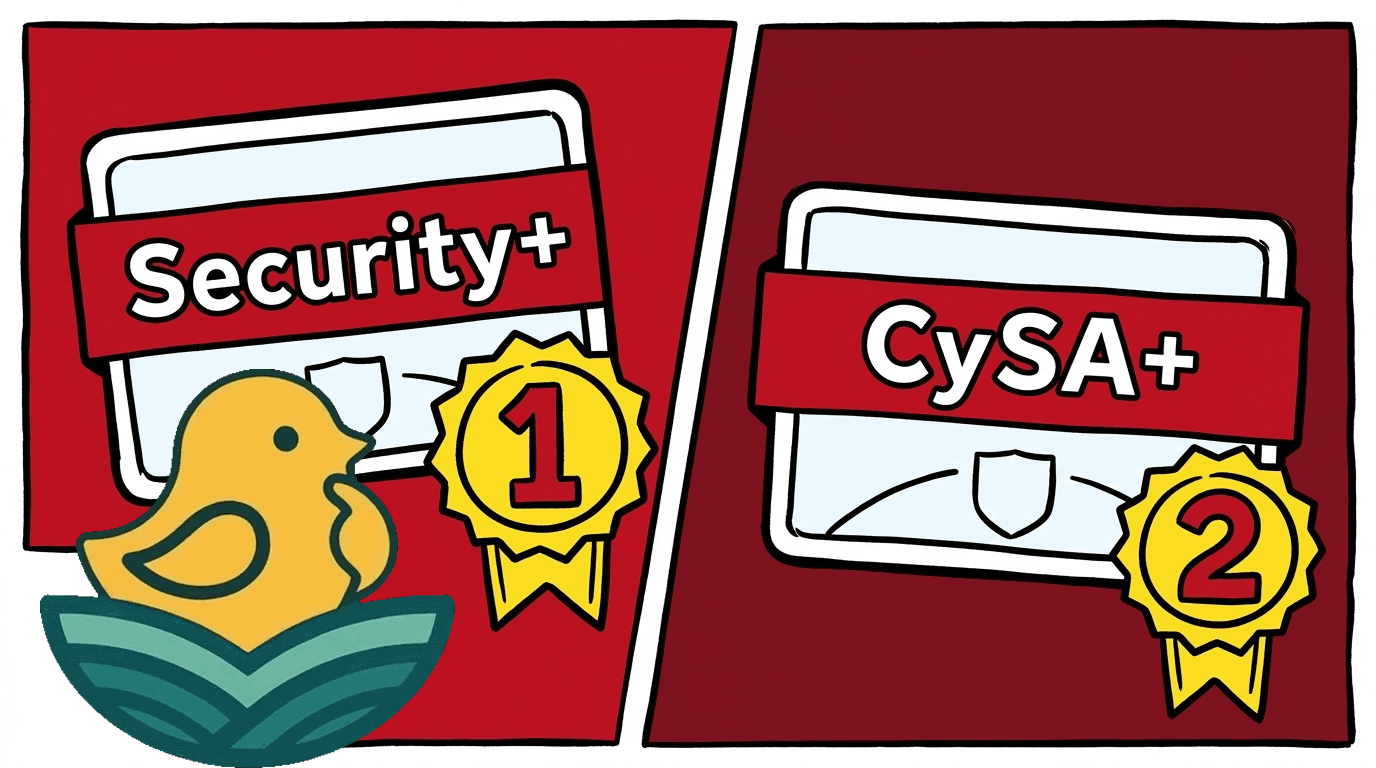
Most people treat CySA+ as the automatic next cert after Security+. The study subs reinforce it: pass Security+, line up CySA+, keep the streak going. But while I was deciding the same thing, I went through a stack of actual SOC analyst and security-tier-1 job ads, and they told a different story. Security+ was the hard requirement, the line in the filter that screens you out if it is missing. CySA+ kept showing up under 'nice to have' or 'or equivalent'. That gap is the whole decision. If you already hold Security+, the honest question is not 'is CySA+ the next step', it is 'is CySA+ the next step for the job I actually want, or am I about to spend two months on a cert hiring managers treat as optional'. Here is how I would order them in 2026, and the one situation where doing CySA+ first is genuinely the right call.

The short answer

Security+ first, almost always. If you do not already hold it, it is the cert that unlocks the most doors per study hour in entry and tier-1 security, and it is the one that appears as a hard filter on the most job ads. CySA+ is a strong second cert, but it is a specialisation, and specialising before you have the baseline is a common way to end up over-certified for the roles you can actually get interviews for.

The exception, which I will get to, is if you are aiming squarely at a detection-and-response role on a government or defence-adjacent contract. In that narrow case the order can flip.

What each cert actually proves

Security+ (SY0-701) is a breadth cert. It proves you understand the whole landscape at a working level: threats and attacks, architecture, identity and access, risk and governance, cryptography basics, incident response at a conceptual level. It is the cert that says "this person can hold a security conversation and will not do anything obviously dangerous". That is exactly what a hiring manager filling a tier-1 or junior security role needs to know.

CySA+ (CS0-004) is a depth cert in one slice: detection and response. It goes deep on log analysis, threat hunting, vulnerability management, and the day-to-day of a SOC analyst. It assumes you already have the breadth and tests whether you can do the analyst job. That is genuinely valuable, but only once you are pointed at the job it describes.

The mistake is reading "CySA+ is harder and more advanced" as "CySA+ is better". It is not better, it is narrower. A narrower cert is more valuable when it matches your target role and less valuable when it does not.

What the job ads actually say

When I read through current SOC analyst and security-tier-1 postings, the pattern was consistent enough to plan around. Security+ showed up as a stated requirement far more often than CySA+, and it showed up in the part of the ad that screens applications. CySA+ tended to appear in the "desirable" or "or equivalent experience" section, the part a recruiter does not actually filter on.

There is a real reason for that beyond habit. Security+ is the cert that satisfies the baseline certification requirements a lot of employers and contracts are written against. In the US defence space specifically, Security+ is an approved baseline for IAT Level II roles under DoD 8140 (the framework that replaced 8570). That single fact puts Security+ on an enormous number of cleared and contractor job descriptions as a non-negotiable, which is why it behaves like a filter and CySA+ behaves like a bonus.

So if you are optimising for "get past the application screen", Security+ does more work. If you already have it, the question becomes whether CySA+ moves you past a different screen, and for most non-SOC-specific roles it does not.

When CySA+ first is actually the right call

Flip the order if all of this is true: you are specifically targeting a SOC analyst or detection-and-response role, you are on or aiming at a US government or defence contract, and the role lists CySA+ as the cyber-defence baseline. DoD 8140 maps certain analyst-track work roles (the cyber defence analyst lane) to CySA+ specifically, not Security+. If that is your exact target, CySA+ is the cert on the filter and Security+ is the bonus, and the order I just argued for reverses.

That is a narrow case. For the much larger pool of people who are 1 to 3 years into a helpdesk or tier-1 role and want to move toward security generally, you are not in it. Security+ first.

The CS0-004 update most posts have not caught up to

If you are reading older advice, you will see CySA+ referred to as CS0-003. That version has moved on. The current exam is CS0-004, and a lot of "should I do CySA+" threads are quietly out of date because they are weighing up the old objectives.

The practical effect for your decision is small but worth knowing: the detection-and-response focus is, if anything, sharper in the current version, which makes the "only do this if you are aiming at the analyst job" advice stronger, not weaker. It is more of a specialist cert now, not less. Check you are studying CS0-004 materials and not CS0-003 leftovers, because the objectives shifted and so did some of the tooling emphasis.

The order I would actually do

1. Security+ (SY0-701) first. Get the baseline that clears the most filters.

2. Then work, not another cert. The single biggest return after Security+ is hands-on time in a role where you touch security work, even tangentially. CySA+ studied with zero analyst exposure is abstract and fades fast. CySA+ studied while you are doing or shadowing SOC work sticks, because the labs map to things you have actually seen.

3. CySA+ (CS0-004) when you are SOC-bound. Once you are pointed at a detection-and-response role, or you are already adjacent to one and want the credential to make the move official, that is when CySA+ earns its study hours.

The thing to avoid is treating certs as a ladder you climb in sequence regardless of where you are trying to go. The ladder framing is why people end up with three certs and no interviews. Match the cert to the next job, not to the cert you did last.

Where ReadRoost fits

Whichever order you land on, the part that actually moves the needle is reps on exam-style questions with explanations, not re-watching videos you have already seen. ReadRoost has practice packs for both Security+ (SY0-701) and CySA+ (CS0-004), with per-domain analytics so you can see which objectives are dragging your score before exam day rather than after. Create a free account, start with the cert that matches your next job, and use the weak-domain breakdown to spend your study time where it changes the result.

Test Your Knowledge

10 questions pulled from the live ReadRoost SY0-701 pack. Answer each one to see where you stand before the exam.

Try 10 Free Questions

Question 1 of 10
General Security Concepts

A company wants to implement a security model that assumes no trust for any user or device, regardless of whether they are inside or outside the corporate network. Which architecture best supports this requirement?

Select your answer below

Knowledge Check (10 questions)

Question 1 ยท General Security Concepts

A company wants to implement a security model that assumes no trust for any user or device, regardless of whether they are inside or outside the corporate network. Which architecture best supports this requirement?

  • Role-Based Access Control
  • Zero Trust
  • Perimeter-based security
  • Defense in Depth

Correct answer: Zero Trust

Zero Trust architecture operates on 'never trust, always verify' - requiring continuous authentication and authorization for every access request regardless of network location. Unlike perimeter security which trusts internal users, Zero Trust treats all access as potentially hostile.

Question 2 ยท Threats, Vulnerabilities, and Mitigations

A security administrator notices unusual outbound connections from a web server to known malicious IP addresses. The server is displaying IoCs associated with data exfiltration. Which attack type is most likely occurring?

  • Denial of service flooding that exhausts the server's connection table
  • Command and control communication
  • ARP poisoning that redirects local subnet traffic to a rogue gateway
  • Man-in-the-middle interception of the server's inbound client sessions

Correct answer: Command and control communication

Outbound connections to malicious IPs with data exfiltration indicators strongly suggest compromised systems communicating with attacker command and control (C2) infrastructure. This is characteristic of advanced persistent threats and malware infections.

Question 3 ยท Security Architecture

An organization wants to host public web servers while protecting internal networks from direct internet exposure. Which network architecture should be implemented?

  • Peer-to-peer network
  • Direct internet connection
  • Intranet only
  • DMZ (Demilitarized Zone)

Correct answer: DMZ (Demilitarized Zone)

A DMZ creates a buffer network between trusted internal networks and untrusted external networks. Public-facing servers (web, email, DNS) reside in the DMZ, protecting internal networks while maintaining external service availability.

Question 4 ยท Security Operations

A security administrator receives an alert about suspicious lateral movement between servers in the data center. Network logs show unusual SMB connections from a compromised workstation. What is the immediate priority?

  • Reboot the domain controller to clear the active malicious SMB sessions
  • Delete the user accounts that initiated the suspicious SMB connections
  • Isolate the compromised workstation and affected servers
  • Update antivirus definitions and run a full scan across every server

Correct answer: Isolate the compromised workstation and affected servers

Immediate containment is critical to prevent further lateral movement and data exfiltration. Isolating affected systems stops the attack progression while preserving evidence for investigation. Other actions follow containment.

Question 5 ยท Security Program Management and Oversight

A European company processes personal data of EU residents. They must obtain explicit consent before collecting data and notify authorities of breaches within 72 hours. Which regulation applies?

  • GDPR (General Data Protection Regulation)
  • SOX (the US law governing corporate financial reporting and controls)
  • PCI-DSS (the payment card industry standard for cardholder data security)
  • HIPAA (the US framework governing protected patient health information)

Correct answer: GDPR (General Data Protection Regulation)

GDPR is the EU data protection regulation requiring lawful basis for processing, consent management, data subject rights, 72-hour breach notification, privacy by design, and potential fines up to 4% of global revenue.

Question 6 ยท General Security Concepts

An organization needs to ensure that a financial transaction cannot be denied by either party after completion. Which security principle directly addresses this requirement?

  • Availability
  • Integrity
  • Confidentiality
  • Non-repudiation

Correct answer: Non-repudiation

Non-repudiation provides cryptographic proof of origin and prevents parties from denying their participation in a transaction. Digital signatures are commonly used to achieve non-repudiation.

Question 7 ยท General Security Concepts

A security administrator is comparing encryption methods. Which statement correctly describes the primary difference between symmetric and asymmetric encryption?

  • Symmetric relies on hashing while asymmetric performs reversible block ciphering
  • Asymmetric encrypts bulk data faster because it skips the key exchange step
  • Symmetric distributes a separate public and private key to every recipient
  • Symmetric uses one shared key; asymmetric uses public/private key pairs

Correct answer: Symmetric uses one shared key; asymmetric uses public/private key pairs

Symmetric encryption (AES) uses a single shared key for both encryption and decryption, making it fast but challenging for key distribution. Asymmetric encryption (RSA) uses mathematically related public and private keys, enabling secure key exchange but with higher computational overhead.

Question 8 ยท General Security Concepts

During a security audit, an analyst discovers that identical passwords produce identical hash values in the database. Which control should be implemented to prevent rainbow table attacks?

  • Increase password length only
  • Use symmetric encryption
  • Implement password salting
  • Disable password complexity

Correct answer: Implement password salting

Salting adds random data to passwords before hashing, ensuring identical passwords produce different hashes. This defeats precomputed rainbow table attacks by requiring attackers to compute hashes for each unique salt.

Question 9 ยท General Security Concepts

A company is designing authentication for a high-security data center. The solution requires users to present a smart card and enter a PIN. Which authentication factors are being used?

  • Something you have and something you know
  • Two instances of something you know
  • Something you are and something you have
  • Something you know and somewhere you are

Correct answer: Something you have and something you know

Smart cards represent 'something you have' (possession factor), while PINs represent 'something you know' (knowledge factor). Together they provide two-factor authentication requiring both possession and knowledge.

Question 10 ยท General Security Concepts

An organization experiences a data breach. Investigation reveals attackers accessed archived data from three years ago that was encrypted with the company's current key. Which cryptographic feature would have prevented access to historical data?

  • Digital signatures that bind each record to its original author
  • Key escrow that stores recovery copies with a trusted third party
  • Perfect Forward Secrecy
  • Certificate pinning that locks each archive to one issuing authority

Correct answer: Perfect Forward Secrecy

Perfect Forward Secrecy (PFS) generates unique session keys for each communication session. Even if long-term private keys are compromised, past session keys cannot be recovered, protecting historical encrypted data.

Full Study Blueprint

See the complete crowdsourced blueprint with all 1 study plan for CompTIA Security+ โ€” resources, ratings, and tips from people who passed.

View Blueprint โ†’

Frequently Asked Questions

Can I skip Security+ and go straight to CySA+?

You can sit CySA+ without Security+, there is no enforced prerequisite. But it is usually a mistake unless you are specifically targeting a SOC analyst role on a contract that lists CySA+ as the baseline. For most people Security+ clears more job filters, so skipping it leaves the higher-value cert undone.

Is CySA+ CS0-003 or CS0-004 now?

CS0-004 is the current version. CS0-003 has been superseded, so make sure your study materials and practice questions are aligned to CS0-004 objectives, not the older release.

Does the order matter for getting hired, or just for learning?

Both, but mostly for hiring. Security+ appears as a hard requirement on far more entry and tier-1 security ads, while CySA+ usually sits in the desirable section. Doing the cert that clears the application filter first gets you in the room sooner.

How long between Security+ and CySA+?

There is no fixed gap, but the highest-return move between them is real work, not back-to-back study. Even a few months of hands-on or SOC-adjacent exposure makes CySA+ stick instead of fading, because the detection-and-response material maps to things you have actually done.

Is CySA+ worth it if I am not going into a SOC?

Less so. CySA+ is a detection-and-response specialisation. If your target is GRC, cloud security, or general security engineering rather than analyst work, your study hours are usually better spent on a cert that matches that lane than on CySA+.

Master Your Exams with ReadRoost

Practice questions, flashcards, and timed exams for 57 certifications.

Related Articles

AZ-900 for non-technical people: what it actually proves (and what it does not)

AZ-900 gets dismissed a lot as the cert you do before the real certs, and that framing misses the people who have no intention of becoming cloud engineers. I have watched project managers, pre-sales consultants, and procurement officers use AZ-900 as the thing that lets them sit in a technical meeting and follow it, rather than nodding along and Googling terms afterwards. For that group the question is not 'is this a stepping stone to AZ-104'. It is 'will 40 hours of study let me stop bluffing in conversations that matter to my job'. The answer is usually yes, with a couple of honest caveats about what the cert does not do. Here is how to decide if you are in a non-technical role and wondering whether AZ-900 is for you.

The CISSP CAT tripped me up until I stopped studying for a multiple-choice exam

I put off the CISSP for years, and when I finally sat down to prepare I made the mistake almost everyone makes: I studied it like a big multiple-choice test. Cram the eight domains, drill the definitions, walk in and recall. The adaptive format quietly punishes that approach, and realising it late in my prep was a frustrating moment I would rather other people skip. The CISSP CAT does not just change how many questions you answer. It changes which questions you see based on how you are doing, and it is built to test how you think, not how much you can recall. If you are a mid-career security professional finally taking the CISSP seriously, here is how the adaptive format should change the way you study, from someone who holds it.

11 Free Claude API Assessment Practice Questions (Updated June 2026)

Anthropic's free "Building with the Claude API" course on Anthropic Academy ends with a graded final assessment that covers the practical surface of the Claude API: the Messages endpoint and roles, streaming, tool use, prompt engineering, vision and document input, error handling, model selection, and safety. The 11 scenario-based practice questions below are mapped to those topics at the same difficulty band as the assessment itself. They are practice questions, not the assessment answers โ€” Anthropic regenerates and rotates the actual items, and any post claiming to have the live questions is misleading. Work through these, read the explanations, and you will be in good shape on exam day.

We improve our products and advertising by using Microsoft Clarity to see how you use our website. By using our site, you agree that we and Microsoft can collect and use this data. Our privacy policy has more details.