
The Real Cost of IT Certifications (Hidden Fees No One Talks About)
Here is a number that surprises most people: the average IT certification costs 3x more than the exam fee listed on the vendor website. The $400 Security+ exam? By the time you factor in study materials, practice tests, potential retakes, and time off work, you are looking at $1,200-$1,500 in real costs. In this guide, I break down every expense—hidden and obvious—so you can budget properly and avoid nasty surprises.

The Obvious Costs
Let us start with what everyone knows: the exam fee itself. As of 2025, here is what major certifications cost:
• CompTIA Security+ (SY0-701): $404 USD • CompTIA Network+: $358 USD • AWS Certified Solutions Architect: $300 USD • Azure Administrator (AZ-104): $165 USD • CISSP: $749 USD • Cisco CCNA: $300 USD
These prices are just the starting point. Vendor websites prominently display these fees because they look manageable. But they represent only 25-30% of your total investment.
The Hidden Costs That Add Up
Here is where your budget starts ballooning:
Study Materials ($150-$500) Textbooks, video courses, and study guides are not optional for most people. A quality video course runs $100-$300. Official study guides are $40-$80. Supplemental books? Another $50-$100.
Practice Exams ($50-$200) You need to test yourself under exam conditions before the real thing. Quality practice exam platforms (like ReadRoost) run $50-$150 for comprehensive question banks. Cheap or free practice tests often have outdated or incorrect answers—penny wise, pound foolish.
Retake Fees ($300-$750) Here is a statistic most vendors do not advertise: 35-45% of candidates fail certification exams on their first attempt. When you fail, you pay the full exam fee again. For CISSP, that is another $749. For Security+, another $404.
Lab Environments ($50-$300) Hands-on practice is essential for many certifications. Cloud sandbox subscriptions, virtual lab platforms, or home lab hardware costs add up quickly.
The Invisible Costs
These costs do not show up on receipts, but they matter:
Time Investment (40-120 hours) At minimum wage ($15/hour), 60 hours of study time represents $900 in opportunity cost. If you are salaried and using vacation days to study, the cost is even higher.
Exam Rescheduling Fees ($50-$100) Life happens. If you need to reschedule your exam within a certain window, vendors charge fees. Pearson VUE charges up to $50 for rescheduling within 48 hours.
Travel Costs (Variable) Not everyone has a test center nearby. If you need to travel to take your exam, factor in gas, parking, meals, or even overnight stays.
Certification Maintenance ($50-$150/year) Most certifications require continuing education credits (CPEs) or renewal fees. CISSP requires annual maintenance fees and CPEs. AWS certifications are valid for 3 years before recertification.
Real-World Budget Examples
Here is what real candidates spent:
Sarah - Security+ (First Attempt Pass) • Exam fee: $404 • Video course: $180 • Practice tests (ReadRoost): $79 • Study guide: $45 • Total: $708
Mike - Security+ (Needed Retake) • Exam fee (1st attempt): $404 • Exam fee (retake): $404 • Video course: $180 • Practice tests: $79 • Extra study materials: $85 • Reschedule fee: $50 • Total: $1,202
Jennifer - CISSP (First Attempt Pass) • Exam fee: $749 • Boot camp: $2,500 • Study materials: $300 • Practice tests: $129 • Hotel (test center 3 hours away): $180 • Total: $3,858
How to Reduce Costs Without Cutting Corners
Smart candidates optimize their spending:
1. Pass on the First Attempt This is the biggest cost saver. Invest in quality study materials and practice exams upfront. A $100 practice test subscription is cheaper than a $400 retake.
2. Use Free Resources Strategically Vendor documentation, YouTube tutorials, and community study groups can supplement paid materials—but do not rely on them exclusively for high-stakes exams.
3. Look for Bundles CompTIA offers exam + retake bundles that save money if you think you might need a second attempt.
4. Employer Sponsorship Many employers pay for certifications. If yours does not, the certification might still be tax-deductible as a professional development expense (consult a tax professional).
5. Choose Quality Practice Tests Free or cheap practice tests with wrong answers cost you more than they save. Invest in verified, up-to-date question banks. ReadRoost offers a free tier with core practice questions—try before you buy.
Is It Worth It?
Despite the costs, certifications deliver strong ROI:
• Salary increases: Security+ holders earn $10,000-$15,000 more than uncertified peers on average • Job opportunities: Many roles require or prefer specific certifications • Career acceleration: Certifications can shortcut years of "paying dues" • Knowledge validation: The process forces you to learn material deeply
The key is budgeting realistically. Do not just save for the exam fee. Save for materials, potential retakes, and the time investment.
Planning your certification journey? Create your free ReadRoost account to explore exam-specific study packs with transparent pricing—no hidden fees, no surprises. Know exactly what you need before you spend a dime.
Frequently Asked Questions
What is the cheapest IT certification to get started?
CompTIA IT Fundamentals (ITF+) and AWS Cloud Practitioner are affordable entry points, both around $100-150 for the exam. They provide foundation knowledge without the high cost of advanced certifications.
Can I get certified for free?
Some employers, workforce development programs, and military/veteran programs cover certification costs completely. Microsoft and AWS also offer free training, though the exam fees usually still apply.
Are boot camps worth the cost?
Boot camps ($2,000-$4,000) can be worth it if you need structured learning and have employer sponsorship. For self-motivated learners, self-study with quality materials is more cost-effective.
How much should I budget for my first certification?
For a mid-level certification like Security+ or AWS Solutions Architect, budget $800-1,200 for first-attempt success. This includes exam fee, study materials, and practice tests. Add 40% more if you want a safety buffer for potential retakes.
Do certifications really increase salary?
Yes. Data from multiple salary surveys shows certified professionals earn 10-25% more than uncertified peers in similar roles. For senior certifications like CISSP, the premium can be 30-40%.
AWS Microcredentials: the free, hands-on badge most people missed
Four AWS security services changed in a single week. Here is what SAA-C03 and SCS-C03 candidates need to know.
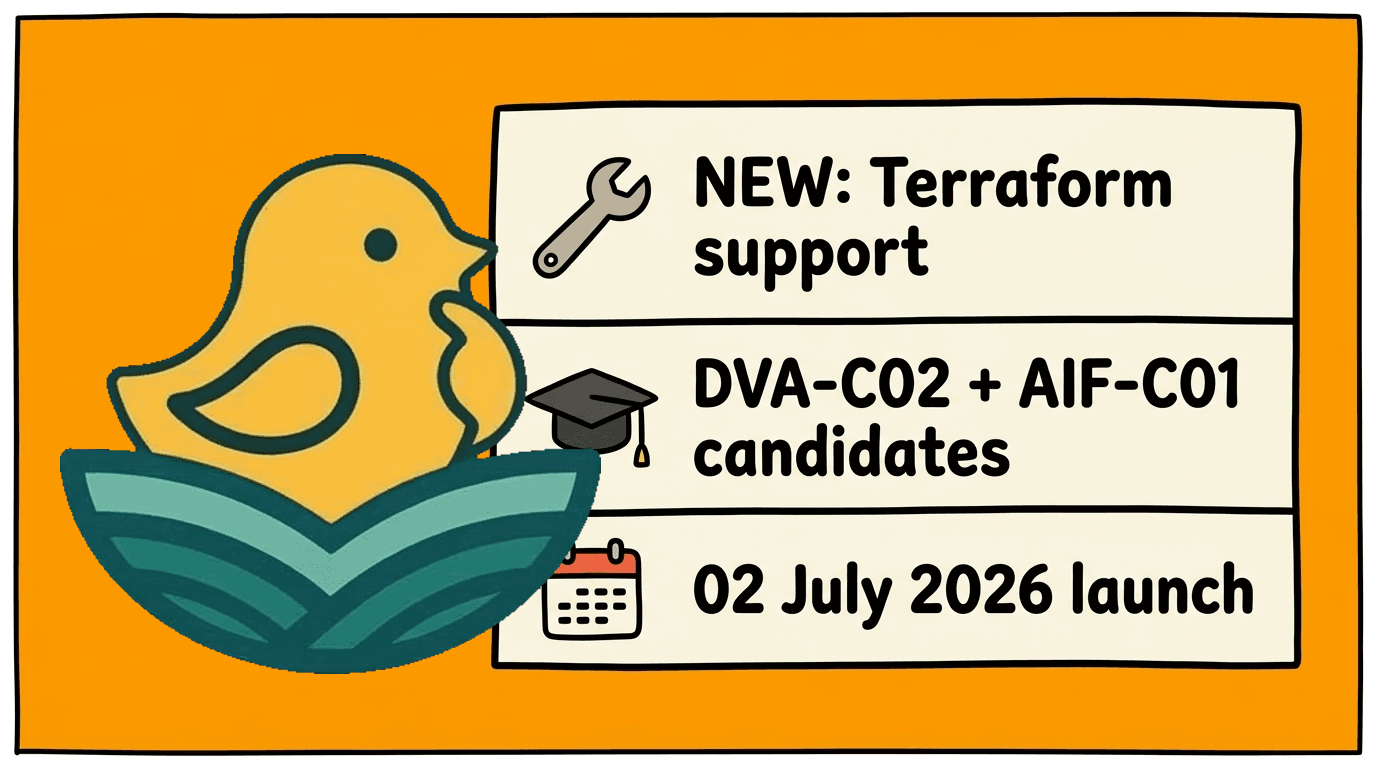
AWS just put Terraform inside SageMaker Unified Studio. Here is what that means for DVA-C02 and AIF-C01.
Reading is good. Practising is better.
Practice questions, flashcards and timed exams for 57 certifications. Start with a free starter pack — no card needed.