
Microsoft DP-100 Retiring June 2026: Your Migration Path to AI-300
Microsoft is retiring the DP-100 Azure Data Scientist Associate exam on June 1, 2026, and replacing it with AI-300: Operationalizing Machine Learning and Generative AI Solutions. If you have been studying for DP-100, you have one month to either sit it before retirement or pivot your prep to AI-300. Here is a clear-eyed look at what is changing, why Microsoft is making the change, and how to migrate without wasting the study time you have already put in.
What is changing on June 1, 2026
On June 1, 2026, Microsoft will retire the DP-100 exam (Designing and Implementing a Data Science Solution on Azure). After that date, the DP-100 sitting is no longer available, and the Azure Data Scientist Associate credential earned via DP-100 enters renewal-only mode: you can renew an existing credential through Microsoft Learn, but new candidates can no longer earn it via DP-100.
The replacement is AI-300: Operationalizing Machine Learning and Generative AI Solutions. AI-300 is already in the catalog and earns the new Microsoft Certified: Azure AI MLOps Engineer Associate credential. Microsoft positioned AI-300 as the spiritual successor to DP-100, but the scope has explicitly shifted from 'data scientist designs and trains models' to 'MLOps engineer ships and operates models, including generative AI workloads.'
Why the change: DP-100 was a 2020 exam in a 2026 industry
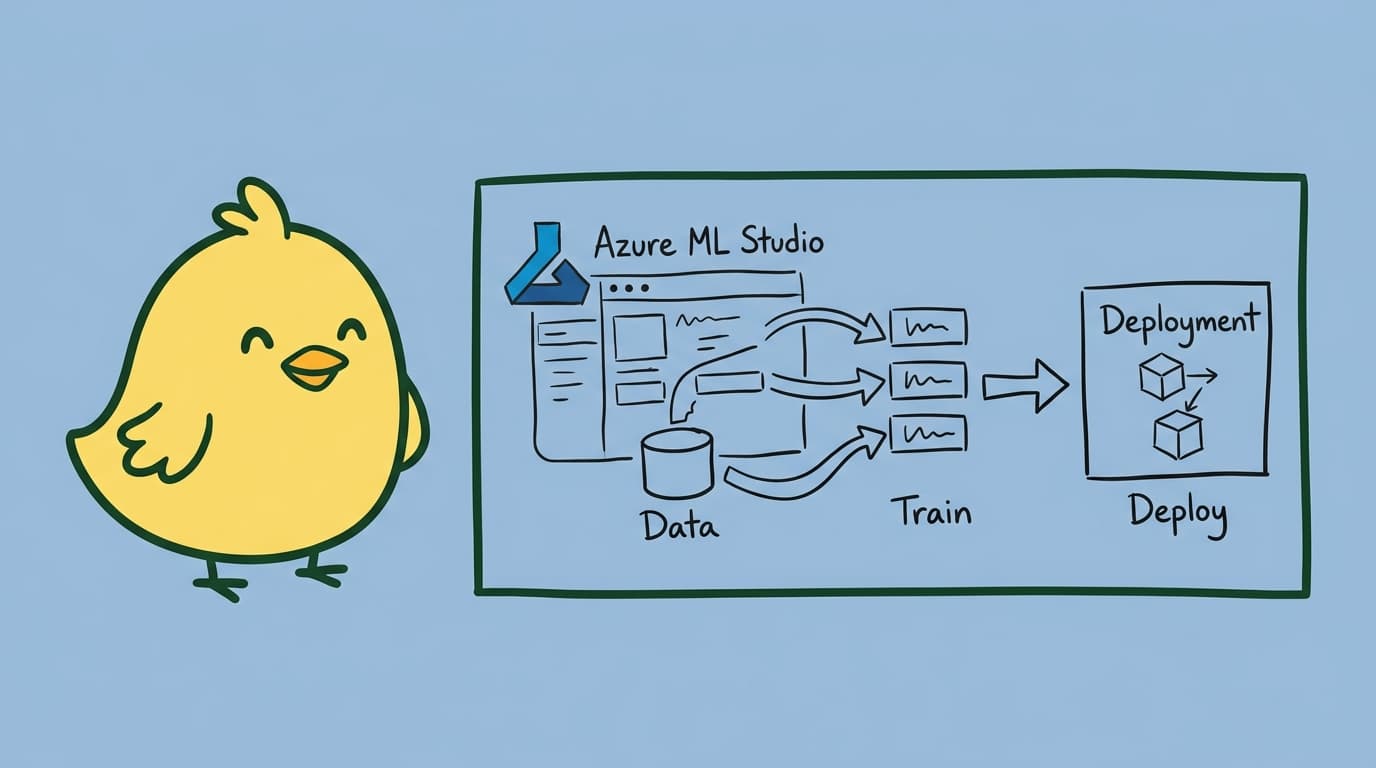
DP-100 was last meaningfully refreshed in 2022 and reflected a world where the typical Azure data-science workflow was: notebook → train a model in Azure Machine Learning → deploy to a managed endpoint. That world still exists, but it is no longer where most net-new Azure ML work is happening. The 2026 reality is generative AI workloads, foundation-model fine-tuning, RAG pipelines, prompt orchestration, and operating LLM-powered apps in production. DP-100 had nothing to say about most of that.
AI-300 explicitly addresses the gap. Microsoft has loaded the new exam with foundation-model lifecycle topics: deploying and managing models from the Microsoft Foundry catalog, evaluating prompts and responses, monitoring drift on generative outputs, content safety and Foundry guardrails, MLOps for both classical and generative pipelines, and CI/CD with Azure ML and GitHub Actions. The audience also shifted: where DP-100 expected you to design models, AI-300 expects you to ship them, closer to a senior MLOps engineer than a research data scientist.
How much of your DP-100 study carries over?
A lot of it does, but not all. The carryover topics include: Azure Machine Learning workspace setup, compute targets, environments, datasets, automated ML, experiment tracking with MLflow, model registry, real-time and batch endpoints, responsible AI (Clarify, Fairlearn), and the broader Azure data ecosystem (Storage, Key Vault, Container Registry). If you are comfortable with those, you are roughly 50-60% of the way to AI-300 already.
What is genuinely new and you will need to study from scratch: Foundry model catalog and prompt flow, RAG-on-Azure-AI-Search architectures, content safety and Foundry guardrails, evaluation methods for generative responses (LLM-as-judge, BLEU/ROUGE limitations), drift and quality monitoring on generative outputs, and CI/CD-style MLOps with Azure ML pipelines and GitHub Actions. Plan two to three weeks of focused study on the generative-AI delta on top of your DP-100 foundation.
Should you take DP-100 before June 1?
If you are within two weeks of being exam-ready on DP-100 right now, the pragmatic move is to sit DP-100 before June 1, claim the credential, and renew on AI-300 content via free Microsoft Learn renewal assessments later. The DP-100 credential remains valid after June 1, only new sittings stop. The catch: a DP-100 credential listed on your CV will visibly age, since the underlying exam is retired.
If you are more than four weeks out, skip DP-100 entirely and pivot to AI-300. The opportunity cost of cramming DP-100 in May is too high when the same study time gets you most of the way through the longer-lived AI-300 credential. You will not save meaningful effort by doing DP-100 first. The carryover works in either direction.
Migration plan: 4 weeks DP-100 → AI-300
Week 1, Foundry foundation: work through the Microsoft Foundry documentation, deploy a model from the Foundry model catalog, run a basic prompt-flow application, and connect a Foundry endpoint to a sample app. Familiarize with the Azure AI Foundry portal and the model evaluation tools.
Week 2, RAG and content safety: build an end-to-end RAG pipeline using Azure AI Search and a Foundry-hosted model. Configure content safety on the Foundry endpoint. Walk through the Foundry-hosted evaluation methods (groundedness, relevance, safety) on a small dataset of your own questions.
Week 3, MLOps: build an Azure ML pipeline that retrains, registers, and deploys a model on a schedule. Wire it to GitHub Actions. Configure model monitoring (data drift on classical models, response quality on generative). Practice rollback scenarios.
Week 4, Practice and exam prep: drill the AI-300 question bank, read the official skills-measured outline carefully, and simulate the exam under timed conditions. The full ReadRoost AI-300 pack at readroo.st/marketplace/ai-300-mlops-engineer covers all five domains and is updated for the 2026 exam outline.
What this means for the Microsoft AI cert track overall
DP-100 retirement is part of a broader 2026 Microsoft cert reshuffle that is moving the entire intermediate Azure-AI track from "build a specific model" to "operate AI in production at enterprise scale." AI-102 (Azure AI Engineer) retires on June 30, 2026 and is replaced by AI-103 (Azure AI App and Agent Developer). AI-900 retires on June 30 and is replaced by AI-901 (Azure AI Fundamentals refresh). PL-200 (Power Platform Functional Consultant) retires August 31 and is replaced by AB-410 (Intelligent Applications Builder). The pattern is consistent: Microsoft is rebuilding the entire mid-tier AI cert ladder around Foundry, agents, and MLOps, and DP-100 → AI-300 is just the most prominent migration on the data-science side.
If you hold DP-100 already, the rational next step in the new ladder is AI-300 followed by AB-100 (Agentic AI Business Solutions Architect, expert-level). If you are starting fresh in 2026, skip DP-100 entirely and start with AI-901 → AI-300, which gets you on the modern certification graph from day one. For the full retirement-and-replacement matrix, see our companion guide to Microsoft certification retirements in 2026.
Frequently Asked Questions
Will my DP-100 credential become invalid after June 1, 2026?
No. DP-100-earned credentials remain valid after the exam retires on June 1, 2026. You can continue to renew the credential through free Microsoft Learn renewal assessments, which now reflect AI-300 content. Only the ability to sit DP-100 as a brand-new exam ends. Your existing DP-100 badge keeps its issue date and your renewal cadence is unchanged.
Is AI-300 harder than DP-100?
Yes, modestly. AI-300 expects MLOps engineering depth (CI/CD, monitoring, rollback) on top of the Azure Machine Learning foundation that DP-100 covered, plus genuinely new generative-AI material (Foundry, RAG, content safety, prompt flow, generative evaluation). Most candidates report two to three additional weeks of study compared to DP-100, dominated by the generative-AI delta. The exam difficulty itself is comparable; the surface area is larger.
Can I use my DP-100 study materials to prepare for AI-300?
Partially. Roughly 50-60% of DP-100 content carries over directly: Azure ML workspaces, compute, pipelines, model registry, MLflow tracking, real-time and batch endpoints, responsible AI tooling (Clarify, Fairlearn), and the broader Azure data ecosystem. What you will need to study from scratch is the generative-AI half of AI-300: Foundry model catalog, prompt flow, RAG pipelines on Azure AI Search, content safety and guardrails, generative evaluation methods, and end-to-end MLOps with GitHub Actions. Plan to add focused study time on those topics rather than re-reading the DP-100 material.
AWS Microcredentials: the free, hands-on badge most people missed
Four AWS security services changed in a single week. Here is what SAA-C03 and SCS-C03 candidates need to know.
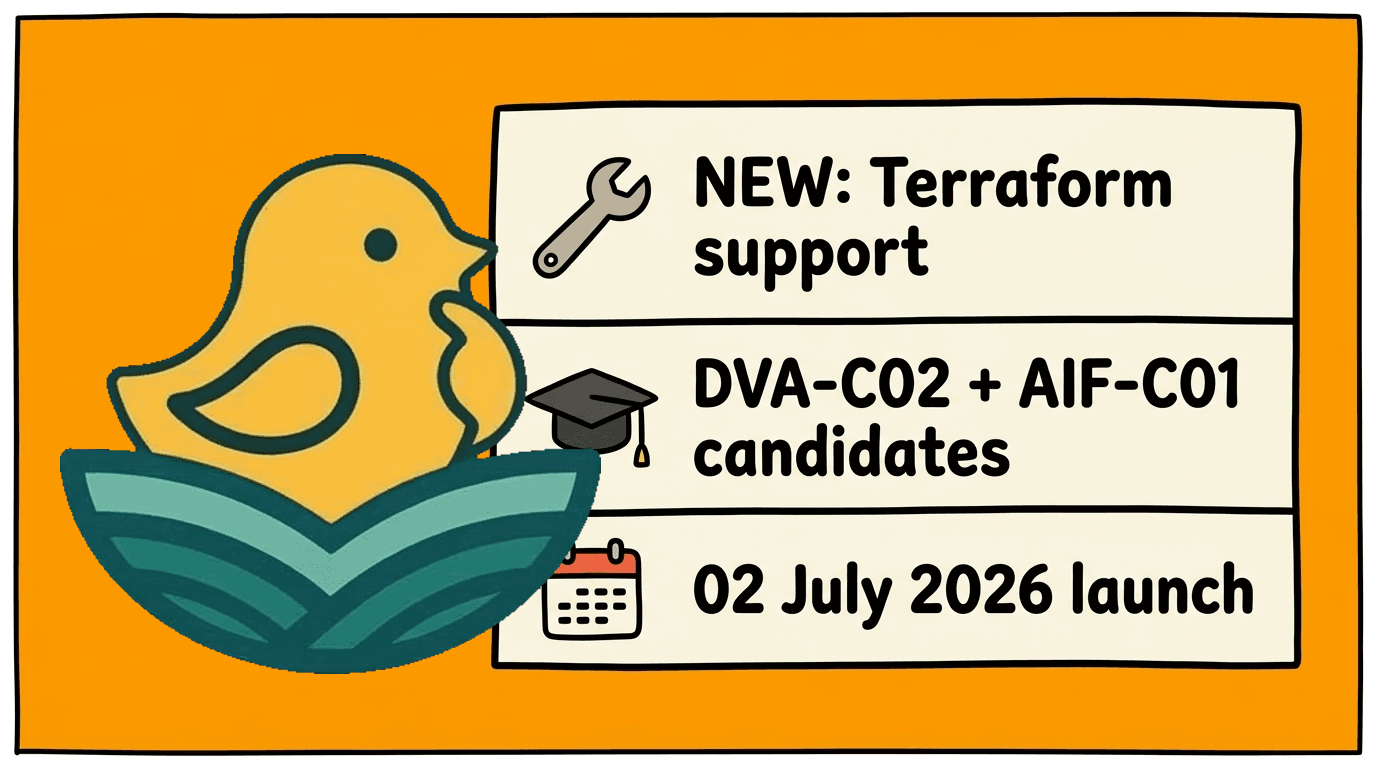
AWS just put Terraform inside SageMaker Unified Studio. Here is what that means for DVA-C02 and AIF-C01.
Reading is good. Practising is better.
Practice questions, flashcards and timed exams for 57 certifications. Start with a free starter pack — no card needed.