
CompTIA Trifecta vs AZ-104 vs CCNA: How I'd Spend $1,324 on Certs in 2026
If you are planning your first IT certifications in 2026, the math is worth re-doing. CompTIA's next voucher price increase is expected later in 2026 (the pattern has been annual 3-7% rises, most recently in June 2025), which means the classic A+/Network+/Security+ trifecta - already $1,324 USD at today's retail prices - is heading higher before it heads lower. So before you commit to the trifecta because every Reddit thread from 2021 said you should, it is worth asking whether it is still the right on-ramp, or whether a single $165 Microsoft AZ-104 or a $330 Cisco CCNA gets you to a job faster for the same money. This guide breaks down what each path actually buys you, who it is right for, and how I would spend a $1,324 cert budget if I were starting over today.
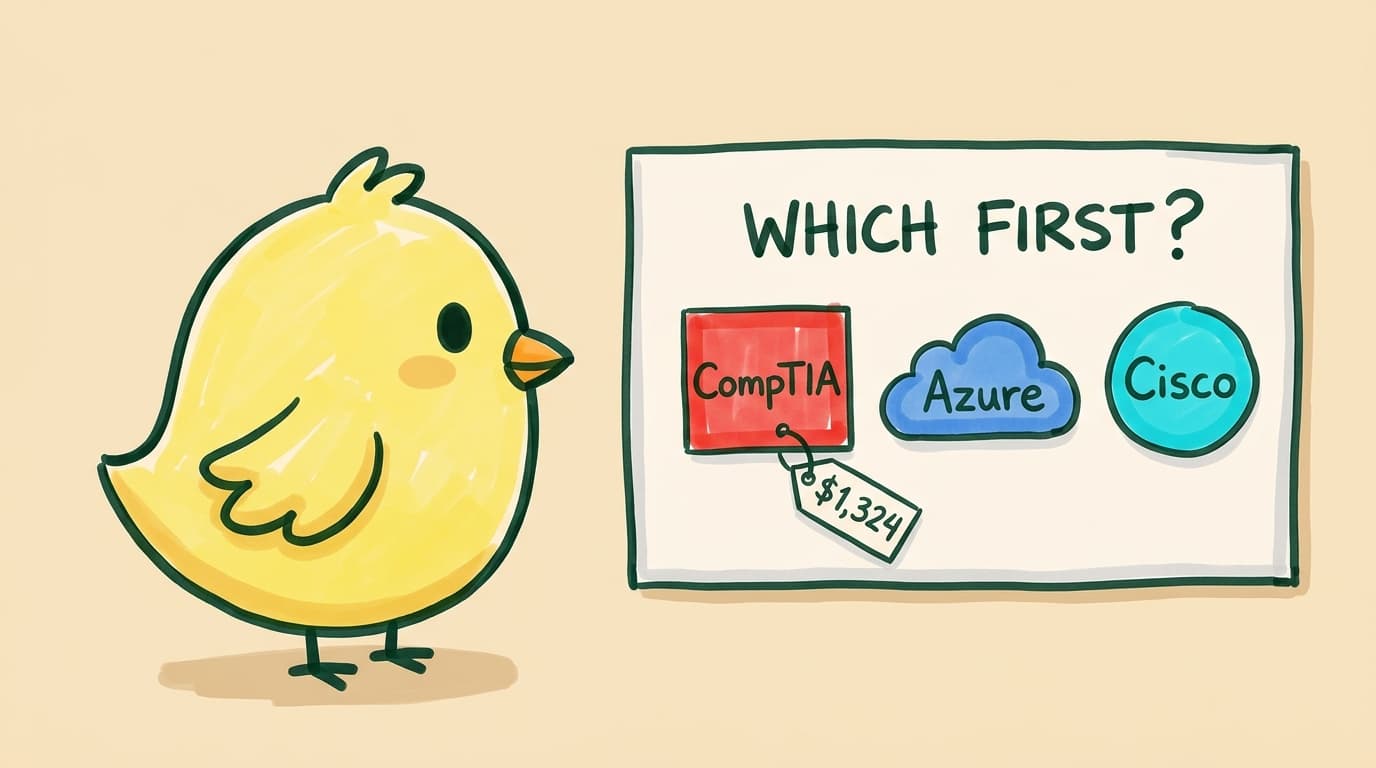
The 2026 CompTIA Price Landscape (And the Rise Coming)
Current 2026 retail voucher prices, before any partner discount: CompTIA A+ is $265 per exam and you need both Core 1 (220-1201) and Core 2, so the A+ alone is $530. Network+ (N10-009) is $369. Security+ (SY0-701) is $425. The trifecta total clocks in at $1,324 USD. For comparison, Microsoft's AZ-104 voucher sits at $165, and Cisco's CCNA (200-301) is $330.
CompTIA raises voucher prices roughly every 12-18 months, in increments of 3-7%. The most recent rise took effect in June 2025. As of May 2026, CompTIA had not posted an effective date for the next rise, but industry watchers point to later in 2026 as the likely window. If you are planning a multi-cert path that you will sit over several months, the rise will probably land before you finish - which is the practical reason to lock in today's price now, rather than the urgency of any specific date.
One useful workaround: authorised CompTIA partners (Get Certified 4 Less, Total Seminars, and similar) buy vouchers in bulk and typically keep selling old-stock at the pre-rise price for 2-4 weeks after a rise lands. A partner voucher bought today usually locks in today's price and is valid for 12 months. That gives you a year of optionality on the actual exam date.
The Trifecta Defended: When It Is Still the Right Path
The trifecta still buys something specific: a vendor-neutral baseline that recruiter filters and HR systems recognise instantly, plus a structured progression from hardware fundamentals (A+) through networking (Network+) to security (Security+). It is genuinely good pedagogy if you are starting from zero, because each cert assumes the previous one. You learn the vocabulary you need before you need it.
It is the right path if all three of these are true: you do not have an IT job yet, you do not yet have a cloud preference (Azure vs AWS vs GCP), and you want the broadest possible set of help-desk and junior-sysadmin doors open. The trifecta is built for the candidate who needs to keep options open while breaking in.
Two specific markets still treat the trifecta - or at least Security+ - as near-mandatory. US Department of Defense and federal contractor roles screen on the DoD 8140 framework, where Security+ is the baseline credential for IAT Level II positions. If your target market includes cleared work, Security+ is not optional. The rest of the trifecta is a strong nice-to-have on those CVs but only Security+ is the hard filter.
When to Skip A+ and Start With Security+
A+ has the lowest return on investment in the trifecta for anyone who already does some IT work informally. If you can already troubleshoot a Windows install, configure a home router, swap RAM in a laptop, and explain the difference between RAM and storage to your parents, you are not the audience for A+. The exam will feel like a vocabulary test in a language you already speak.
The popular Reddit advice - skip A+, do Network+ and Security+ - is right for people in tech-adjacent roles wanting to formalise toward security: existing helpdesk workers, IT-curious software developers, sysadmins moving toward a security pivot. You save $530 and roughly two months of study time on content you already know.
The hidden cost of skipping is HR filters. Some early-career postings still list A+ as a required or preferred credential, particularly MSPs and federal subcontractors. If your target market has those filters and you skip A+, you are choosing to lose some interviews. Check three to five real job postings in your target city and target role before deciding. If A+ appears in zero of them, skip it. If it appears in two of five, the maths gets harder.
AZ-104: $165 For an Azure Admin Foothold
Microsoft's AZ-104 (Azure Administrator) voucher is $165 USD - roughly one-eighth the cost of the trifecta. It tests practical Azure administration: identity and governance with Microsoft Entra ID, storage configuration, virtual networking, compute (VMs, App Services, container services), and monitoring. It is a single 40 to 60 question exam in roughly 100 minutes.
The job market signal is sharper than people credit it for. 'Azure Administrator' is an immediate-hire title in any organisation already invested in Microsoft 365, which is most mid-market companies in English-speaking markets. AZ-104 is the credential that maps directly onto the role title - hiring managers know exactly what it tests, and the interview shifts from 'do you know cloud' to 'can you actually run Azure'.
The cost: AZ-104 assumes you already have IT fundamentals. Going straight to AZ-104 with zero IT background is brutal. If you are starting fresh, pair it with AZ-900 (Azure Fundamentals, $99) first - that combination still comes in at $264 total, less than half the cost of A+ alone, and gets you to an Azure Admin job posting credibly within four months. ReadRoost has a free AZ-104 study guide at readroo.st/blog/az-104-study-guide and the AZ-104 practice question bank at readroo.st/marketplace/az-104-azure-administrator.
CCNA: $330 For Real Networking Depth
Cisco's CCNA (200-301) costs $330 USD. It goes substantially deeper on networking than Network+: dynamic routing protocols (OSPF, EIGRP), VLANs and trunking, ACLs, wireless, and the beginnings of network automation with Python and APIs. It is a single 120 minute exam with around 100 to 120 questions including simulations and lab-style items.
The job market signal is specific. CCNA is the entry-level credential for network-engineer roles: NOC technician, junior network engineer, ISP support, MSP networking. If your target employer runs Cisco gear (which is most enterprises, telcos, ISPs, and large MSPs), CCNA carries weight that Network+ simply does not. Network+ proves you know networking concepts; CCNA proves you can sit at a Cisco CLI and configure it.
The cost is real: CCNA is meaningfully harder than Network+, and the typical study time roughly doubles - plan four to six months of part-time study from a networking-curious baseline. First-attempt fail rates are higher than CompTIA exams. You also need to learn Cisco's specific CLI and IOS conventions, which add depth Network+ does not require. ReadRoost does not currently have a CCNA practice pack, so the honest study recommendation here is Cisco's own learning materials plus Packet Tracer for hands-on labs.
If I Were Starting Over: Three Personas, Three Paths
All three paths below are priced at pre-rise 2026 voucher costs and assume you buy through an authorised partner where possible. None of them are universally right - they map to specific target roles. Pick the persona closest to you and run that path.
Persona 1: No IT job yet, broad target. Path: A+ ($530) plus Security+ ($425), skip Network+. Total around $955. You keep the help-desk credibility A+ buys you, you reach Security+ for the security on-ramp and the DoD 8140 filter, and you save $369 on Network+ content you can pick up on the job. Practice with ReadRoost's free A+ Core 1 set at readroo.st/blog/comptia-a-plus-core-1-practice-questions-free and the Security+ set at readroo.st/blog/security-plus-sy0-701-practice-questions-free.
Persona 2: Tech-adjacent, want to specialise in cloud security. Path: AZ-900 ($99) into AZ-104 ($165) into Security+ ($425). Total around $689. You build an Azure-shaped CV with a security capstone, you spend half what the trifecta costs, and you point at a specific role type - cloud security engineer or Azure admin with a security focus. This is the path I would pick today if I were starting over with even a year of helpdesk experience.
Persona 3: Networking-curious, want to be a network engineer. Path: Network+ ($369) into CCNA ($330). Total around $699. Skip A+ and Security+ for now - you can grab Sec+ later if a security pivot makes sense, and A+ adds little for someone who already wants to live in network gear. This is the cheapest path to a credible 'network engineer' line on a CV.
Each of these three is meaningfully cheaper than the full trifecta and targets a specific role type instead of optimising for breadth. The trifecta is still defensible for someone who genuinely needs all doors open, but most readers in 2026 already know which door they are trying to walk through.
The Honest Part: Certs Are Filters, Not Job Offers
Whichever path you pick, the cert does one job: it gets you past automated HR screening and onto the shortlist. The job offer comes from somewhere else. It comes from the projects you can demonstrate, the home lab you have actually run, the GitHub commits, the LinkedIn posts that describe what you learned out loud, and the network of people who will vouch for you when their employer is hiring.
The implication is that you should build something while you study. Spin up a free Azure tenant and document what you set up. Run a small home network in Cisco Packet Tracer and screenshot the topology. Stand up a Sysmon-monitored Windows VM and write up what you saw in the logs. Six honest LinkedIn posts about what you learned will outperform a clean cert with no story behind it, every time.
The cert plus the artifacts converts. The cert alone increasingly does not.
Frequently Asked Questions
When are CompTIA prices going up in 2026?
As of May 2026, CompTIA had not posted an official effective date for the next rise. The 2025 rise landed in June at roughly 5-7%, and the broader 12-18 month pattern points to the next adjustment landing later in 2026. If you are planning to sit any CompTIA exams over the next several months, a partner voucher bought today locks in the pre-rise price for 12 months - which removes the timing question entirely.
Is the CompTIA trifecta still required to get a job in 2026?
No. It is a strong path for vendor-neutral, broad-target candidates, but cloud-leaning targets (AZ-104) and network-engineer targets (CCNA) reach the same job market with less spend. The strongest case for the trifecta in 2026 is US defence and federal contracting, where Security+ in particular is a near-mandatory baseline under DoD 8140 for IAT Level II positions.
Can I skip A+ and go straight to Security+?
Yes, with caveats. If you already speak fluent IT, A+ is mostly review and you save $530. If your target employers screen on A+ (some MSPs and federal subcontractors do), skipping it costs you interviews. Check three to five real job postings in your target city and target role before deciding - if A+ appears in zero of them, skip it without guilt.
AZ-104 vs Security+: which should I do first?
AZ-104 if you want a job title fast (Azure Administrator is an immediate-hire role at most M365 shops) and you do not have a security clearance or US defence target. Security+ if your target is US defence or federal contracting, or you already have an Azure foundation. They are complementary credentials, not competing ones.
Is the CCNA harder than CompTIA Network+?
Materially harder. Most people study CCNA for four to six months versus four to six weeks for Network+. The reward is a deeper networking foundation, hands-on Cisco CLI experience, and recognition with network-engineer hiring managers. The cost is the time and a higher first-attempt fail rate.
Will old vouchers honour the old price after the 2026 rise?
Yes. CompTIA vouchers bought before a price rise honour the price they were sold at, up to the voucher's expiry (typically 12 months from purchase). Authorised partners often keep selling old-stock vouchers at the pre-rise price for 2-4 weeks after a rise lands - that 2-4 week window is the cheapest place to be if you mistime your purchase.
AWS Microcredentials: the free, hands-on badge most people missed
Four AWS security services changed in a single week. Here is what SAA-C03 and SCS-C03 candidates need to know.
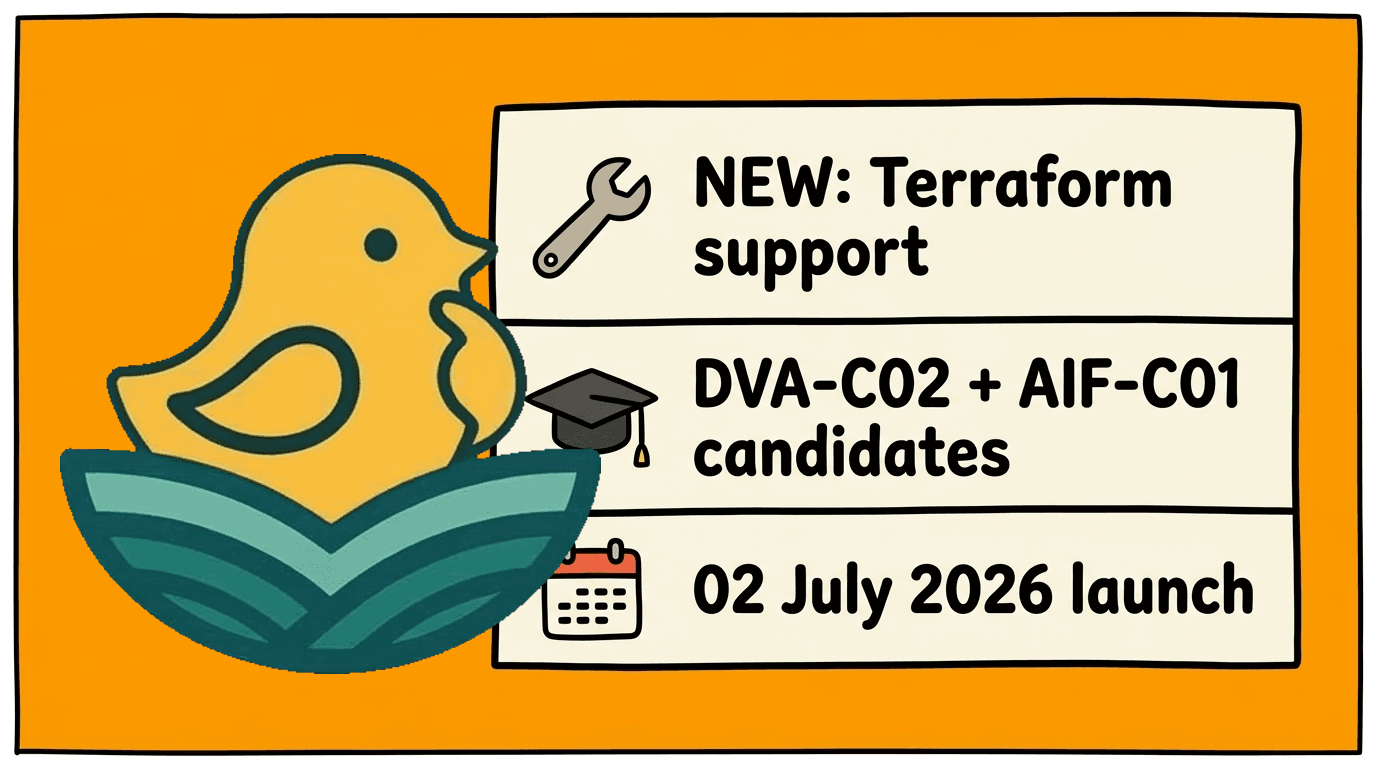
AWS just put Terraform inside SageMaker Unified Studio. Here is what that means for DVA-C02 and AIF-C01.
Reading is good. Practising is better.
Practice questions, flashcards and timed exams for 57 certifications. Start with a free starter pack — no card needed.