
AZ-900 for non-technical people: what it actually proves (and what it does not)
AZ-900 gets dismissed a lot as the cert you do before the real certs, and that framing misses the people who have no intention of becoming cloud engineers. I have watched project managers, pre-sales consultants, and procurement officers use AZ-900 as the thing that lets them sit in a technical meeting and follow it, rather than nodding along and Googling terms afterwards. For that group the question is not 'is this a stepping stone to AZ-104'. It is 'will 40 hours of study let me stop bluffing in conversations that matter to my job'. The answer is usually yes, with a couple of honest caveats about what the cert does not do. Here is how to decide if you are in a non-technical role and wondering whether AZ-900 is for you.
What AZ-900 actually proves
AZ-900 (Azure Fundamentals) proves you understand cloud concepts and the shape of Azure at a conversational level. Not how to build things. How to talk about them accurately. It covers what the cloud is and why organisations move to it, the core Azure services and what each is for, security and identity basics, and the bits non-technical people actually collide with most: pricing models, cost management, and the shared responsibility model.
That last cluster is the quiet reason it is so useful off the technical track. Pricing, licensing, and "who is responsible when something breaks" are exactly the conversations a PM, a pre-sales consultant, or a procurement officer has to hold their own in. AZ-900 gives you the vocabulary and the mental model for those without pretending you can architect a solution.
Who it is actually for
Microsoft has been pushing organisations to nominate cloud champions in non-technical departments, which is sending a fresh wave of business-side people toward this cert. Three profiles where it pays off clearly:
The project manager running a cloud migration or a SaaS rollout. You do not need to deploy anything. You need to know when a developer is quoting a realistic timeline, what a "lift and shift" actually involves, and why "just put it in the cloud" is not a plan. AZ-900 closes the gap between you and the engineers you are coordinating.
The pre-sales consultant or account manager selling into IT. You are in rooms where a customer asks a technical question and the engineer is not on the call. AZ-900 is the difference between "let me get back to you on that" every time and being able to handle the basic ones credibly, which is what keeps a sales conversation moving.
The procurement or finance officer signing off on cloud spend. Cloud billing is genuinely confusing, and that is where money leaks. Understanding consumption pricing, reserved instances, and what drives a bill lets you ask the questions that catch a bad contract before it is signed.
What it does not prove (be honest about this)
AZ-900 will not make you technical, and it will not get you a technical job. If your plan is to use it as a career pivot into a cloud engineering role, it is not enough on its own and you would be better off treating it as step one of a longer path (AZ-104 next, plus real hands-on practice).
It also will not let you call a bluff at depth. You will be able to follow a technical conversation and ask good questions. You will not be able to verify whether an engineer is wrong about something subtle. That is fine, because that is not the job. Just go in clear that the cert buys you fluency, not expertise.
And it is not a respect-token with engineers if you misuse it. The fastest way to lose a technical team is to wave a fundamentals cert around as if it makes you their peer. Used quietly, to understand them better, it earns goodwill. Used loudly, it does the opposite.
Is it worth 40 hours of your time?
Yes, if you regularly sit in conversations where cloud terms, pricing, or responsibility get decided and you currently feel one step behind. The return is not a line on your CV, it is fewer meetings where you are guessing. For most business-side roles that touch IT, that payback is quick.
No, if you touch cloud topics once a quarter and can comfortably ask a colleague. In that case the 40 hours is better spent elsewhere, and you can pick up what you need on demand.
The honest test: count the meetings in the last month where you nodded along to something cloud-related you did not actually follow. If that number is more than a couple, AZ-900 will pay for itself in confidence alone.
How to study it if you are non-technical
Study it differently from someone on the engineering track. They are building scaffolding for future hands-on certs. You are building working vocabulary, so optimise for understanding the concepts and their trade-offs, not for memorising service names you will never type.
Lean hard on the pricing, cost management, and shared responsibility material, because that is the part you will use weekly. Spend less worry on the long lists of service names. Know what the major categories are for (compute, storage, networking, databases) and what problem each solves, rather than drilling every individual product.
Practice questions matter more than reading here, because the exam asks you to apply concepts to little scenarios, and scenarios are exactly the format your real conversations take. ReadRoost has an AZ-900 practice pack with explanations written to teach the why, not just mark you right or wrong, plus per-domain analytics so you can see whether your weak spot is pricing, security, or core services before you book the exam. Create a free account and run a few sets early, so the studying you do is aimed at the gaps that actually exist.
Full Study Blueprint
See the complete crowdsourced blueprint with all 1 study plan for Microsoft Certified: Azure Fundamentals — resources, ratings, and tips from people who passed.
Frequently Asked Questions
Is AZ-900 worth it if I never plan to be technical?
Yes, if your role puts you in cloud-related conversations regularly. The value for non-technical people is conversational fluency and confidence in pricing and responsibility discussions, not a technical career move. If you rarely touch the topic, it is probably not worth the time.
How long does AZ-900 take to study for a beginner?
Most non-technical candidates need roughly 20 to 40 hours over a few weeks. You can move faster than an engineer in some areas because you are aiming for understanding rather than implementation detail, but the pricing and shared-responsibility material rewards extra time.
Will AZ-900 help me get a job?
On its own, not a technical one. As a credibility signal on a business-side CV (project management, pre-sales, procurement that touches IT) it helps you stand out and shows initiative. As a pivot into cloud engineering it is only the first step, not a qualification.
Is AZ-900 too easy to bother with?
It is an entry-level exam, but easy and pointless are not the same thing. For a non-technical professional the point is not difficulty, it is the working vocabulary it gives you. The fact that it is achievable in a few weeks is a feature, not a knock against it.
Should a non-technical person do AZ-900 or AWS Cloud Practitioner?
Match the cert to your environment. If your organisation runs on Azure or Microsoft 365, AZ-900 maps to the conversations you actually have. If it is an AWS shop, do CLF-C02 instead. The cloud you work near matters far more than which fundamentals exam is marginally easier.
AWS Microcredentials: the free, hands-on badge most people missed
Four AWS security services changed in a single week. Here is what SAA-C03 and SCS-C03 candidates need to know.
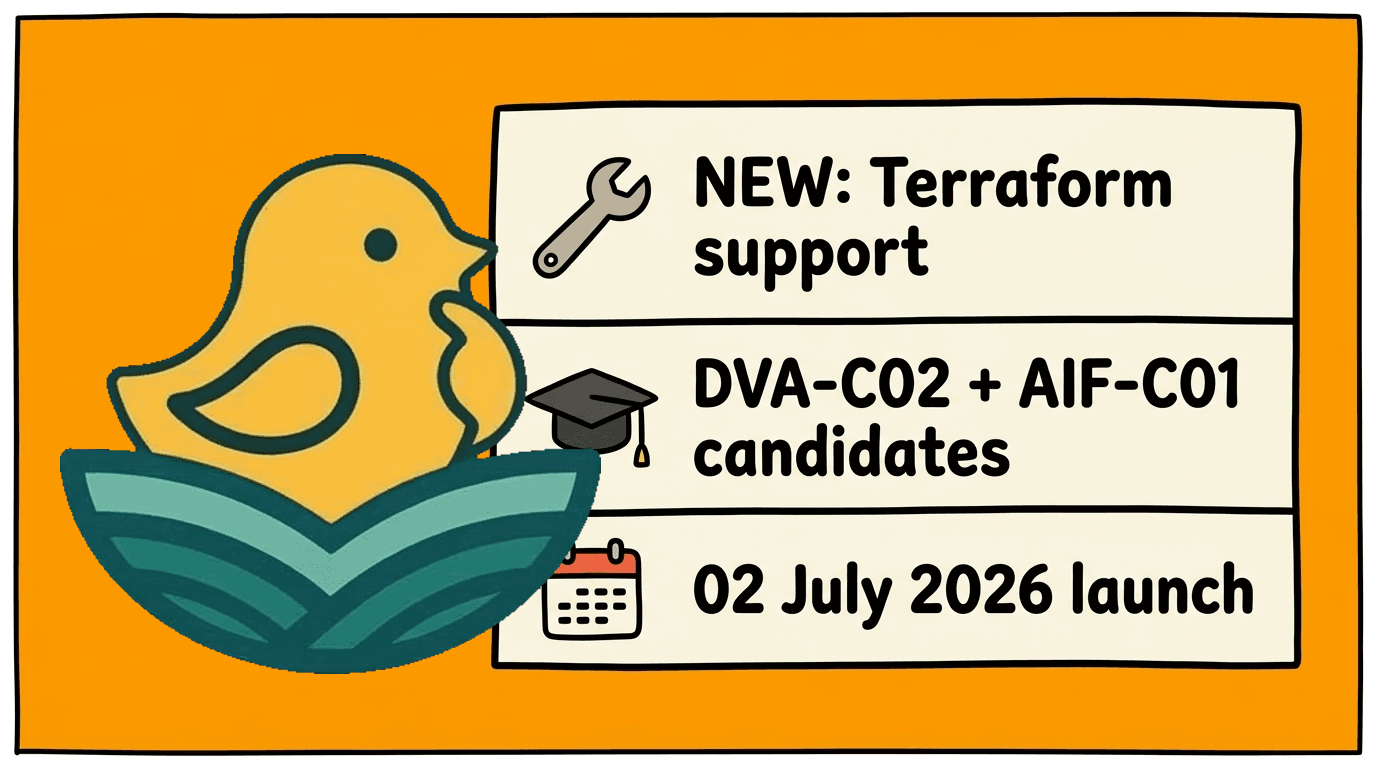
AWS just put Terraform inside SageMaker Unified Studio. Here is what that means for DVA-C02 and AIF-C01.
Reading is good. Practising is better.
Practice questions, flashcards and timed exams for 57 certifications. Start with a free starter pack — no card needed.