
The AWS Forgetting Curve: Why You Lose Half By Renewal Time
If you passed your first AWS certifications in the remote-work boom of 2022 or 2023, your three-year recertification cycle is hitting right around now. The threads on r/AWSCertifications this month are telling the same story: people who passed SAA-C03 or SAP-C02 cleanly the first time around are sitting down with a renewal practice question and freezing on something they used to nail in their sleep. It is not laziness. It is how human memory works when you stop retrieving information daily. The Ebbinghaus forgetting curve has been documenting this since 1885 - we forget around half of what we learn within the first day, around three-quarters within a week, and somewhere north of 80% within a year unless we actively review. Cramming once every three years is not a study strategy. It is repeated suffering. There is a better way, and the research behind it is settled enough that medical schools have built their curricula around it.
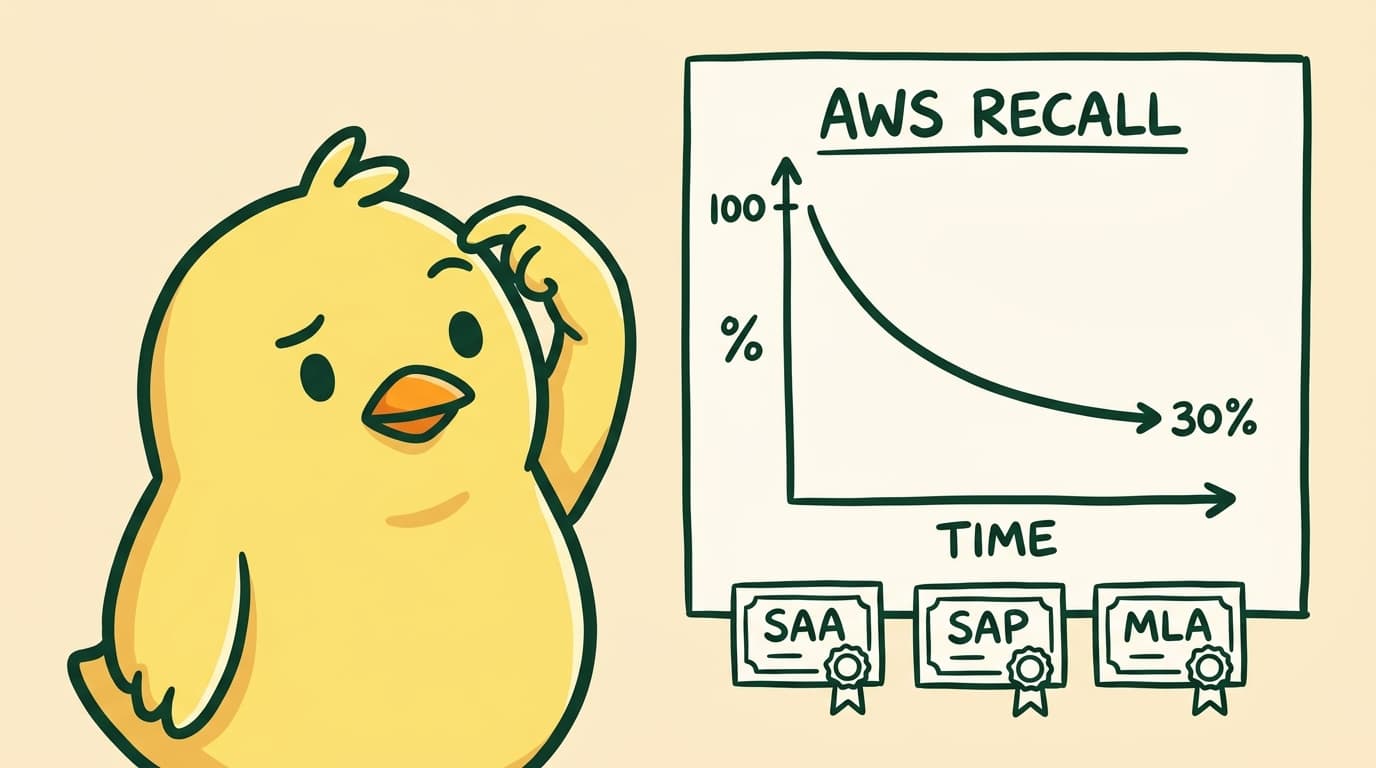
The Pattern: Half Your AWS Knowledge Is Already Gone
Three years ago a meaningful slice of the IT industry sat their first AWS exam. Cloud Practitioner, then SAA-C03, sometimes a Specialty if they were ambitious. The 2022-2023 cohort was huge. They are now hitting their three-year renewal window all at once - and the same shape of Reddit post keeps showing up. "Sat down to start studying for my SAA renewal, opened a practice question on networking, could not remember the difference between a NAT gateway and a NAT instance. Last time I took this exam I taught a coworker this."
The instinctive read is that this is a personal failing - that they got lazy, or stopped caring. That is not what is happening. What is happening is a 140-year-old psychology result called the Ebbinghaus forgetting curve, and it applies to every human being who has ever learned anything they did not subsequently keep using.
Hermann Ebbinghaus published his self-experiments on memory in 1885. He found that without active review, memory of new material decays predictably: roughly 50% of what you learn is forgotten within the first day, 70-80% within 24 hours of any one study session, and 77%+ within a week. The exact percentages vary by individual and material, but the shape of the curve is stable across more than a century of replication. AWS knowledge is not magically immune. You learned a concept under pressure, used it for an exam, then mostly stopped retrieving it daily on the job. The decay started immediately.
If you are a year or two post-cert and have moved into a role where you use only a slice of what the exam covered, you are not imagining the gap. It is real. It is normal. And it is the reason re-cramming for renewal feels almost as hard as learning the material from scratch.
Why Cramming Again at Renewal Feels Like Starting Over
The natural response to a renewal deadline is to do what worked the first time: block out two months of evenings, grind through a practice question library, watch through the same Stéphane Maarek or Adrian Cantrill course, sit the exam. It works. It also requires the same amount of effort the original cert did, because most of the knowledge has reset.
There is a worse version of this pattern. People pass the renewal, breathe out, and then stop reviewing again the moment the exam result lands. Three years later the same decay has happened. The cycle repeats. Over a 9-12 year AWS career someone might cram for SAA three or four times, each time treating it as a fresh learning task because each time it largely is.
The reason this is so common is that no one teaches IT certification candidates about retention. The whole industry is structured around "how to pass" content - practice exams, cheat sheets, study plans, mnemonic videos. Almost none of it talks about what happens after. The implicit assumption is that you will pick up enough on the job to keep the knowledge fresh. For some people in some roles, that works. For the much larger group of people who use 20% of an AWS cert's content in their daily work and never touch the other 80%, it does not.
The Science of Stopping the Forgetting
The fix is not exotic. It is one of the most replicated findings in cognitive psychology: the spacing effect. Information reviewed at increasing intervals - one day, three days, seven days, two weeks, a month - is retained dramatically better than information reviewed in a single concentrated session. Each review "resets" the forgetting curve, and the subsequent curve decays more slowly. Done correctly, you can hold 90% retention with a fraction of the total study time cramming would require.
The same mechanism that medical schools have been quietly adopting over the last decade is the one that holds AWS knowledge across a three-year recert window. Anki - the open-source flashcard tool built on the SuperMemo spaced-repetition algorithm - has been independently associated in published research with higher USMLE Step 1 scores and better in-service exam performance among residents. The candidates using Anki are not smarter. They are letting an algorithm decide which facts to show them on which days, and the algorithm is good at picking the moments just before they would have forgotten.
The default Anki spacing pattern is roughly: review after 1 day, then 3 days, then 7 days, then 14, then 28, then longer. By the time a card has matured (around 21+ days between reviews) you are seeing it perhaps once every two or three months and retaining it at over 90%. Across an entire AWS cert's worth of facts (maybe 500-700 atoms of knowledge), that works out to 5-15 minutes of review per day to hold the lot.
This is the central insight that makes recertification a different problem from initial certification. The initial cert is a sprint. Recertification, done badly, is another sprint. Done well, it is a continuous trickle of two-minute review sessions across three years, with the algorithm doing the scheduling so you do not have to.
What Doesn't Work (And Why It Feels Like It Should)
A few approaches feel like they should solve this and mostly do not.
Re-watching the same course you watched for the original cert. Passive video consumption is the lowest-yield form of review. You are recognising material, not retrieving it. Recognition feels like understanding ("yes I know this") but does not strengthen the recall pathway that the exam actually tests. You will finish the course feeling refreshed and then sit the practice exam and freeze on questions you would have answered automatically two years ago. The video felt useful; the test result will be honest.
Re-reading your own notes from the original prep. Same problem. Reading is recognition. Without the friction of trying to retrieve the answer before you see it, the recall pathway does not get the workout that builds durable memory. Notes are useful as a reference, not as a study tool on their own.
Doing one giant practice exam two weeks before the renewal date. This identifies what you have forgotten but does not give the spacing intervals time to do their work. You discover gaps too late to drill them across the spacing schedule that would actually hold them.
Subscribing to AWS What's New emails and assuming exposure equals retention. It does not. Passive exposure to a service name in a marketing email is not the same as retrieving the underlying concept from memory. The What's New feed is useful for awareness; it does not move the needle on the recert exam.
How ReadRoost Is Built for This (And Where We Are Honest About Limits)
ReadRoost is structured around the spaced-repetition pattern from the ground up. Each AWS pack - SAA-C03 (509 questions, 300 flashcards), SAP-C02 (508 + 300), DVA-C02, MLA-C01 (500 + 306), AIF-C01 (427 + 221), AIP-C01 (1,029 + 517), DOP-C02, plus CLF-C02 - is built so the questions and flashcards in it can be drilled on a spacing schedule rather than as a one-time crammed run. The same set of cards comes back at the intervals at which you are about to forget them, so the knowledge gets stronger across weeks and months rather than briefly memorised and dropped.
The mechanism is the same Anki and Duolingo built their reputations on, ported into a cert-prep context. The difference is that ReadRoost's content is built specifically for AWS exam blueprints with scenario-shaped questions, rather than the generic flashcard format Anki users have to build themselves. The whole catalog is free at readroo.st/marketplace - we do not paywall the SRS or any of the cert content.
What ReadRoost does not do: rebuild the hands-on AWS muscle. If you have not touched the console or run a CLI command in eighteen months, you also need to spend some hours in a real AWS account before your renewal. SRS holds conceptual recall. It does not, on its own, keep your fingers familiar with the IAM JSON policy syntax or the order of arguments to `aws s3 sync`. Use ReadRoost for the recall, use a free-tier AWS account for the muscle memory, and the two together close the gap.
A Practical Retention Plan: 10 Minutes a Day, Across Three Years
If you have an AWS cert with a three-year expiry, here is the simplest plan that actually holds the knowledge.
Months 1-3 after passing: This is when the forgetting curve is steepest. 10 minutes a day of spaced-repetition review across your cert's question bank. The cards you got wrong on the practice exams should be weighted heavily - those are the gaps the SRS algorithm should prioritise. By the end of month three, the bulk of the material has been reviewed three or four times and is moving into matured intervals.
Months 4-24: 5-10 minutes a day, with the algorithm now showing you mostly matured cards at 1-3 month intervals. New cards only appear when you add a new pack (a new cert) or when a previously-easy card has decayed back into needing attention. This is the trickle phase. The total time investment is roughly an hour a week.
Months 25-36 (renewal window): Dial back up to 10-15 minutes a day. Add one full timed practice exam at the 6-week-before mark and another at the 2-week-before mark. The bulk of the work has already been done across the previous 24 months - this phase is just confirming what you know and identifying anything that has slipped.
Compare that against the alternative: 60-80 hours of concentrated cram time in the 8 weeks before renewal. The trickle approach is the same total time across three years but distributed in a way that matches how memory actually works. The difference at the exam is not subtle - one cohort sits the renewal feeling like the material is familiar; the other cohort sits it feeling like they are seeing the questions for the first time.
Multi-Cert Holders: The Compounding Wins
The benefit compounds when you hold more than one AWS cert. People who pass SAA-C03, then DVA-C02, then MLA-C01 (the common AWS practitioner-to-engineer ladder) end up with three certs all expiring within roughly the same window. Without a retention plan, that becomes three concurrent crams every three years.
With spaced repetition across all three packs running on the same daily 10-15 minute session, the overlap actually helps. AWS concepts repeat across exams - VPC fundamentals, IAM, S3 storage classes, KMS - and reviewing them in a multi-cert SRS schedule reinforces them more often, not less. The renewal effort scales sub-linearly: a third cert added to your stack roughly doubles the daily review time, not triples it, because so much of the content overlaps.
This is the strongest argument for using a single tool that covers your whole AWS cert stack rather than separate flashcard decks per cert. The whole point of the spacing algorithm is to surface the right card on the right day across all your knowledge, not within an arbitrary per-cert silo.
What to Do This Week
If you are already inside the renewal window and the recall is gone: start with one full timed practice exam to identify the biggest gaps, then commit to 15 minutes a day of weighted spaced repetition until the exam date. You will not retrieve every concept by exam day, but you will close 70-80% of the gap with a fraction of the time a full cram would take.
If you passed within the last year and want to avoid the cliff: start the 10-minute-a-day pattern now. Today, ideally. The forgetting curve is most aggressive in the first few weeks after learning, so the earlier you start the spacing, the less material has already decayed and the less catch-up review is needed.
If you are sitting your first AWS exam soon: build the SRS habit during prep, not after. Use the same tool you cram with for the daily review afterwards, so the transition from cramming-mode to maintenance-mode is invisible. The candidates who do this never have a recertification cliff because they never let the recall decay in the first place.
Whichever camp you are in, the underlying principle is the same. Knowledge is not a thing you have. It is a path your brain has to keep walking. Walk it daily, even briefly, and it stays clear. Stop walking it for three years and you will need to clear it again with a machete. The forgetting curve is not your fault. It is just the rule.
Frequently Asked Questions
How much do you forget after passing an AWS certification?
Following the Ebbinghaus forgetting curve, you lose around 50% of new knowledge within the first day if you do not actively review it, around 70-80% within 24 hours of any one study session, and over 80% within a year. The exact decay varies by person and by how much of the content you continue to use on the job - someone who uses VPC daily will retain VPC knowledge fine and lose the SageMaker material instead.
What is spaced repetition and why does it work for AWS certs?
Spaced repetition is the practice of reviewing material at increasing intervals (typically 1, 3, 7, 14, 28+ days) rather than in one concentrated session. Each review resets the forgetting curve and the subsequent curve decays more slowly, so total retention rises while total study time falls. It works for AWS certs because most cert content is conceptual recall (how does X service work, when do you choose Y over Z) which is exactly what spaced repetition is designed to hold.
How long do AWS certifications last before recertification?
AWS certifications are valid for three years from the date you pass. You can recertify by passing the current version of the same exam (or, for some certs, a higher-tier exam in the same domain). AWS occasionally retires or rebrands exams; if your cert covers a retired exam, AWS publishes a successor path.
Is it cheaper to recertify or cram from scratch every three years?
The exam cost is identical either way. The difference is your time. A three-year trickle of 10 minutes daily is roughly 180 hours of total study time, distributed - but the per-week load is genuinely small (around an hour). A pre-renewal cram is typically 60-80 concentrated hours over 8 weeks. Most people who try both report the trickle approach feels much less stressful, and the renewal exam feels markedly easier.
Does ReadRoost have spaced repetition for AWS packs?
Yes. ReadRoost is built around the spaced-repetition pattern for all of its packs, including the AWS catalog (SAA-C03, SAP-C02, DVA-C02, MLA-C01, AIF-C01, AIP-C01, DOP-C02, CLF-C02). The whole catalog is free. The questions and flashcards in each pack are scheduled so the cards you are about to forget come back at the right intervals - same mechanism Anki and Duolingo built their reputations on, applied to cert content.
Can I just use Anki for AWS cert retention?
Yes, you can build your own Anki deck and it will work well - Anki is a mature, well-studied tool. The trade-off is that you have to build the cards yourself, which is significant work for a 500-700 atom cert. ReadRoost's AWS packs are pre-built with scenario-shaped questions and explanations and run on the same spaced-repetition principle, so the bring-up cost is zero. Either choice beats no SRS at all.
Do I still need to use AWS hands-on alongside spaced repetition?
Yes. Spaced repetition holds conceptual recall - what services do what, which one to choose in a scenario, how IAM policies are structured. It does not keep your fingers familiar with the console or the CLI. If you have not touched a real AWS account in over a year, plan a few hours of hands-on time in a free-tier account in the weeks before renewal. The combination of SRS + hands-on closes the gap. SRS alone closes most of it.
AWS Microcredentials: the free, hands-on badge most people missed
Four AWS security services changed in a single week. Here is what SAA-C03 and SCS-C03 candidates need to know.
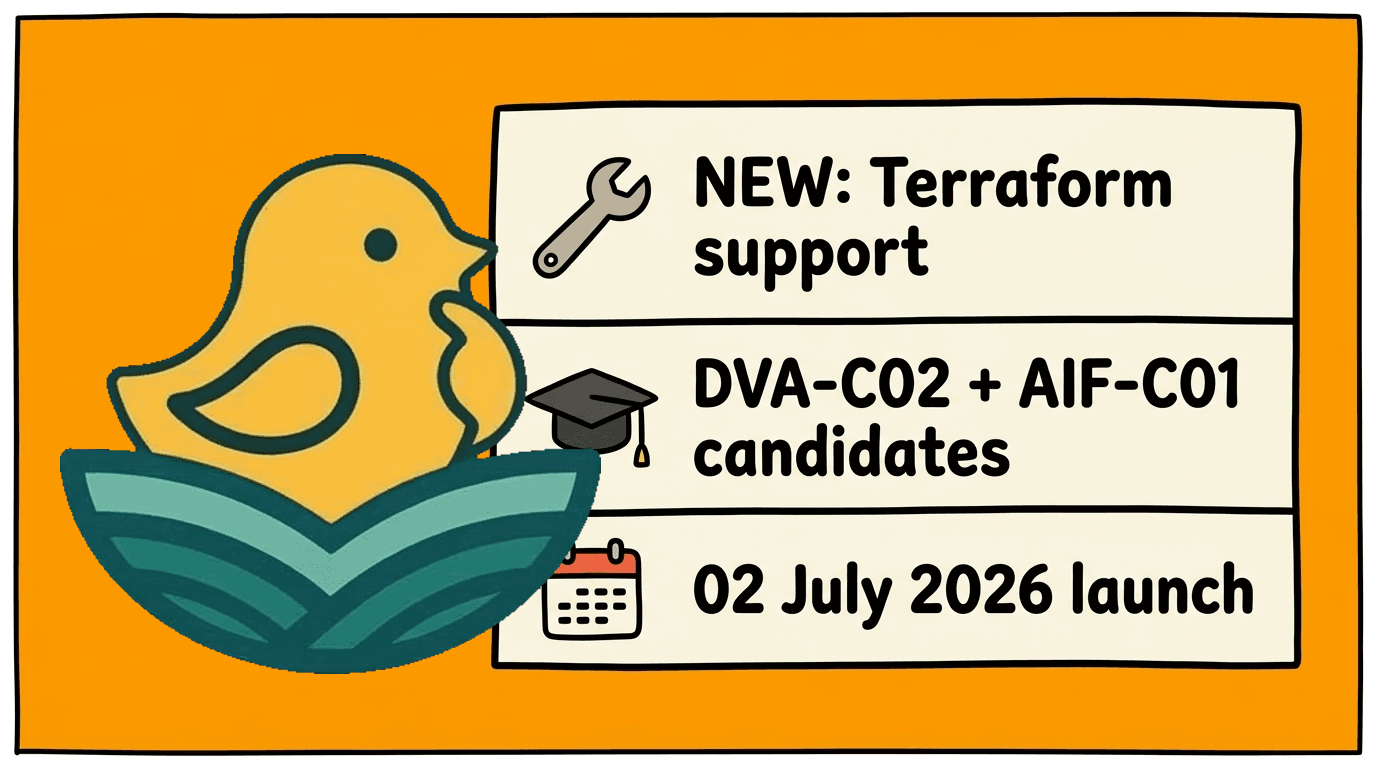
AWS just put Terraform inside SageMaker Unified Studio. Here is what that means for DVA-C02 and AIF-C01.
Reading is good. Practising is better.
Practice questions, flashcards and timed exams for 57 certifications. Start with a free starter pack — no card needed.