
AB-620 AI Agent Builder Practice Questions: 20 Free Questions for Microsoft's New Beta Exam (2026)
AB-620 — Microsoft's brand-new AI Agent Builder Associate beta exam — opened on April 21, 2026, and the first 300 candidates can sit it for 80% off using promo code AB620Sunny26 before May 12, 2026. This is the deepest Copilot Studio exam Microsoft has ever published: Power Fx, Dataverse, Microsoft Foundry, the Model Context Protocol (MCP), Agent2Agent (A2A), agent flows, computer-use agents, Azure AI Search RAG, and Power Platform ALM all show up. Below are 20 hand-authored practice questions weighted to match the official skills-measured outline (30-35% planning, 40-45% integration, 20-25% testing). Try each one, then read the explanation. The full 250-question AB-620 bank is at readroo.st/marketplace/ab-620-ai-agent-builder.
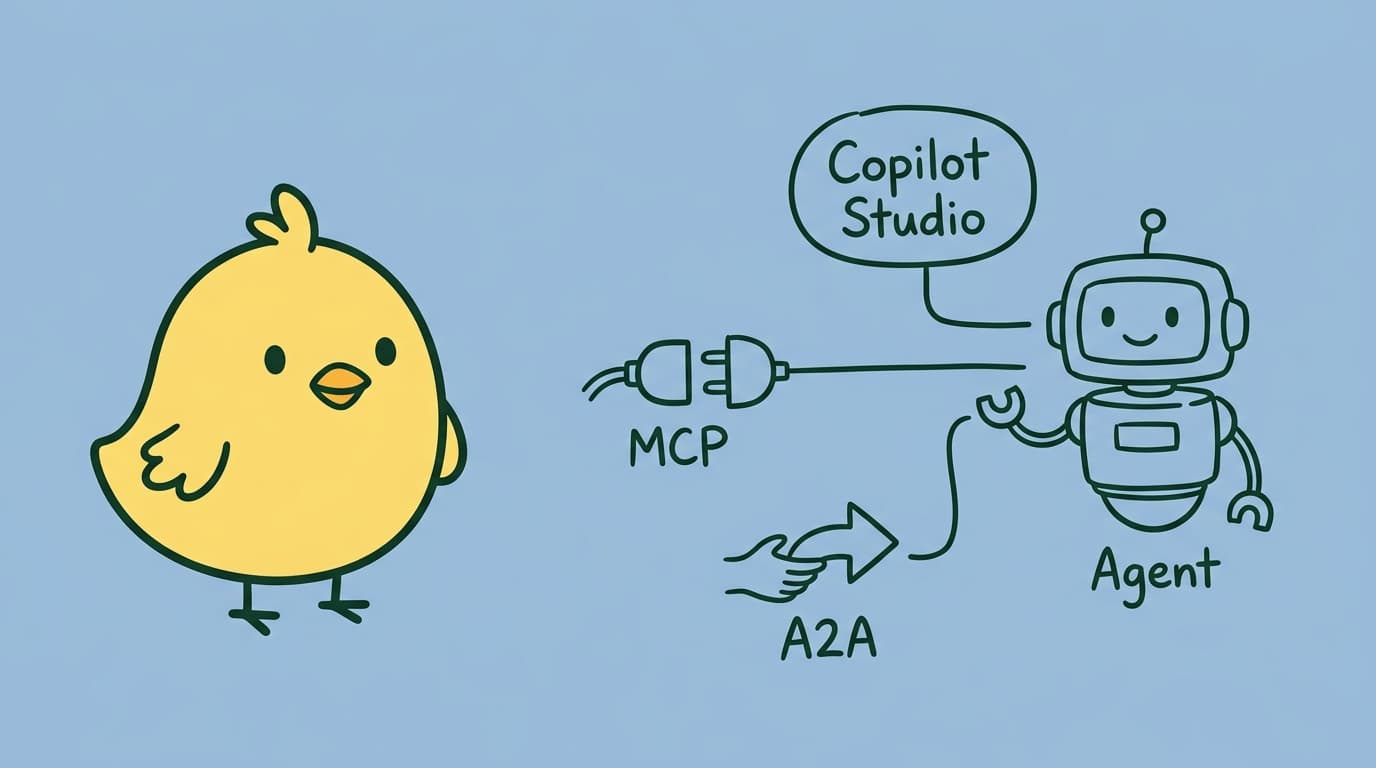
Try 5 Free Questions
Question 1 of 5A company is deploying a Copilot Studio agent solution to its production environment. The administrator wants to prevent unintended customizations directly in the production environment while still allowing updates from the development team. Which solution type should be deployed to production?
Select your answer below
About the AB-620 AI Agent Builder Beta Exam
AB-620 is officially titled 'Designing and Building Integrated AI Agent Solutions in Copilot Studio' and earns the Microsoft Certified: AI Agent Builder Associate credential. Microsoft published the study guide on April 9 2026 and opened beta seats on April 21. It is the most technical Copilot Studio certification to date — far more developer-focused than the AB-900 (Copilot agent administration) credential. Passing score is 700/1000.
The exam targets professional developers, ISV partners, and Power Platform consultants who already build with Power Fx, Dataverse, and the Microsoft Power Platform. Microsoft expects you to bring intermediate generative-AI literacy into the room: foundation models, retrieval-augmented generation (RAG), the Model Context Protocol, and the Agent2Agent (A2A) protocol all appear in skills-measured. You should also be comfortable with REST APIs and OAuth 2.0 — about a third of the integration domain assumes you can wire up custom connectors and Send HTTP request nodes.
The AB620Sunny26 promo code gives the first 300 beta candidates 80% off, and it expires on May 12, 2026. After that, AB-620 stays in beta at full price until general availability in June 2026. If you want first-mover bragging rights and pay $24 instead of $165, this is the window — and our 250-question pack at readroo.st/marketplace/ab-620-ai-agent-builder covers every objective on the published outline.
Quick Answer Key (for Scanning After You Try the Questions)
Try each question first. This key is here for post-test review. 1-B, 2-A, 3-C, 4-B, 5-B, 6-B, 7-B, 8-A, 9-B, 10-A, 11-B, 12-A, 13-A, 14-A, 15-B, 16-B, 17-B, 18-B, 19-A, 20-B. If you score 16+ you are exam-ready. The most commonly missed questions on this set are Q5 (generative answers grounding strictness), Q9 (A2A vs MCP), Q12 (Copilot connector vs custom connector), and Q15 (custom connector with OAuth vs Send HTTP request).
AB-620 Exam Domain Breakdown
Microsoft published three domains for AB-620, with these weightings: 1. Plan and configure agent solutions — 30-35% (planning, identity, channels, responsible AI, agent flows, topics, adaptive cards, generative answers, custom prompts, variables) 2. Integrate and extend agents in Copilot Studio — 40-45% (Copilot connectors, Power Platform connectors, Azure AI Search, computer use, MCP tools, REST APIs, multi-agent A2A, Foundry integration, Fabric data agents, Application Insights) 3. Test and manage agents — 20-25% (test sets, evaluation methods, ALM via Solutions, environment variables, Power Platform Pipelines)
The 20 questions below distribute as 7 from Domain 1, 9 from Domain 2, and 4 from Domain 3 — roughly matching the official weights. If you miss two or more in any single domain, that's your study target. The full ReadRoost AB-620 pack is built off the same blueprint and contains 250 scenario-based questions with explanations and 125 review flashcards.
Questions 1-7: Plan and Configure Agent Solutions
Domain: Plan and configure agent solutions | Difficulty: Moderate 1. Your team is integrating a Copilot Studio agent with an on-premises ERP system that exposes only a SOAP API. The agent must be able to read order status from the ERP. Which integration approach should you recommend? A) Add a Send HTTP request node and call the SOAP endpoint directly from the topic B) Build a Power Platform custom connector that wraps the SOAP API and use the on-premises data gateway for connectivity C) Use the generative answers node and point it at the SOAP WSDL D) Configure an MCP tool with the SOAP endpoint URL
Correct Answer: B A Power Platform custom connector wrapping the SOAP API gives you a reusable, governed integration that the agent can call as a tool. The on-premises data gateway provides the secure tunnel from Microsoft's cloud to the on-prem ERP. Send HTTP request nodes don't natively handle SOAP envelopes well, generative answers is for grounded retrieval over content, and MCP tools target HTTP/JSON servers — not SOAP.
Domain: Plan and configure agent solutions | Difficulty: Moderate 2. You are configuring a customer-facing Copilot Studio agent that accepts free-text questions which may include personally identifiable information (PII). What is the recommended way to prevent the agent from echoing PII back into responses or surfacing it in logs? A) Configure responsible AI guardrails (content moderation and PII redaction) at the agent level and enable Microsoft Foundry content filters on any custom prompts that send user input to a model B) Add a topic that detects keywords like "SSN" and ends the conversation C) Set the agent to log only the first 100 characters of each turn D) Disable Application Insights so PII is never written to telemetry
Correct Answer: A Responsible AI guardrails plus Foundry content filters address both ingress (filtering user input before it reaches the model) and egress (filtering model output for harmful or sensitive content). Keyword-based topic interception is brittle and misses the long tail of PII formats. Truncating logs and disabling telemetry remove visibility but do nothing to prevent PII from appearing in responses to the user.
Domain: Plan and configure agent solutions | Difficulty: Hard 3. An agent runs in user context (delegated permissions) but needs to read records from a Dataverse table that the calling user does not have access to. What identity pattern is appropriate? A) Add the user to the security role that grants table access — there is no other supported pattern B) Use Send HTTP request and pass an admin's bearer token in the header C) Configure the action to run as an Application user (service principal) in Dataverse, scoped to only the privileged read it needs D) Disable Dataverse row-level security on the table
Correct Answer: C When the caller cannot have direct access but the agent must perform a privileged read, the supported pattern is to register an Application user (service principal) in Dataverse and have the action use that identity, scoped to the minimum capability required. Granting the calling user the elevated role defeats the purpose of role-based access control. Hard-coding admin tokens is a security anti-pattern, and disabling row-level security exposes other rows.
Domain: Plan and configure agent solutions | Difficulty: Foundation 4. A reimbursement agent flow must pause and wait for a manager to approve before continuing the next action. Which Copilot Studio agent flow capability should you use? A) Multi-step generative answers with iterative prompts B) A human-in-the-loop agent flow with an approval action that suspends execution until the approver responds C) A scheduled flow that re-runs every five minutes and checks a flag column D) Adaptive cards with Action.Submit
Correct Answer: B Human-in-the-loop agent flows are designed for exactly this scenario: the flow suspends, sends an approval request, and resumes when the approver responds. Generative answers don't suspend execution. Polling flows are wasteful and don't carry context cleanly. Adaptive cards collect input but don't suspend a long-running flow on their own.
Domain: Plan and configure agent solutions | Difficulty: Hard 5. You configure a topic to answer policy questions from a SharePoint knowledge base. Compliance requires that responses must quote source content verbatim and never paraphrase. Which configuration achieves this? A) Use a generative answers node with the default summarization settings B) Use a generative answers node with strict grounding configured (responses must include direct citations and the response generation is constrained to extract from the source content rather than summarize) C) Use a custom prompt that asks the model to "be accurate" D) Use Send HTTP request to fetch each policy and return the raw text
Correct Answer: B Strict grounding in the generative answers node forces the response to come directly from the cited content with explicit references rather than free-form summarization. Default summarization rephrases content. "Be accurate" prompts do not enforce verbatim quoting. Returning raw policy text with Send HTTP request bypasses the agent and produces no semantic search.
Domain: Plan and configure agent solutions | Difficulty: Foundation 6. A user-facing agent needs to collect a structured form (name, email, request type from a dropdown, urgency from radio buttons) inside the chat. Which Copilot Studio feature is the right tool? A) A topic with five separate text input questions B) An adaptive card containing Input.Text and Input.ChoiceSet fields, submitted via Action.Submit C) A Send HTTP request node that opens a Microsoft Forms URL D) An agent flow with a Question action per field
Correct Answer: B Adaptive cards render structured forms inside the chat and return all fields in a single Action.Submit payload, which the topic then processes. Sequential text questions are slower for the user and don't match the structured form requirement. Linking out to Microsoft Forms breaks the conversational flow. Per-field flow questions are unnecessarily verbose.
Domain: Plan and configure agent solutions | Difficulty: Moderate 7. An agent flow collects a customer ID from the user and must keep that value available across multiple subsequent topics in the same conversation. What is the appropriate variable scope? A) Topic-scoped — set the variable inside the topic that captures it B) Global (conversation-scoped) — the variable persists for the lifetime of the conversation across topics C) System variable — overwrite a built-in variable like User.DisplayName D) Use environment variables defined in the Solution
Correct Answer: B Global (conversation-scoped) variables persist across topics within the same conversation, which matches the requirement of having the customer ID available to multiple later topics. Topic-scoped variables disappear when the topic ends. Overwriting system variables is unsupported and will break built-in behavior. Environment variables are for ALM-time configuration (e.g., per-env API URLs), not runtime conversation state.
Questions 8-16: Integrate and Extend Agents in Copilot Studio
Domain: Integrate and extend agents in Copilot Studio | Difficulty: Moderate 8. You want your Copilot Studio agent to call an internal MCP (Model Context Protocol) server that exposes inventory-lookup tools to language models. What configuration step is required in Copilot Studio? A) Add an MCP tool to the agent, supply the MCP server URL and authentication credentials, and let the model auto-discover the tools the server publishes B) Build a custom connector that re-implements every MCP tool the server exposes C) Add a Send HTTP request node for each MCP tool you intend to use D) Register the MCP server as a Power Platform connection only — no MCP-specific configuration is needed
Correct Answer: A Copilot Studio supports MCP tool registration natively: you provide the server URL and credentials, and the agent discovers and uses the tools the MCP server exposes without per-tool configuration. The whole point of MCP is auto-discovery, so re-implementing each tool as a custom connector defeats the purpose. Send HTTP requests don't carry MCP semantics. There is MCP-specific tool configuration; a generic Power Platform connection isn't sufficient.
Domain: Integrate and extend agents in Copilot Studio | Difficulty: Hard 9. A Copilot Studio agent needs to delegate a research task to a Microsoft Foundry-hosted agent and wait for its response. Which protocol does Microsoft recommend for this multi-agent collaboration? A) The Model Context Protocol (MCP) — register the Foundry agent as an MCP tool B) The Agent2Agent (A2A) protocol — register the Foundry agent in Copilot Studio and orchestrate the call via A2A C) REST API only — there is no protocol-level integration between Copilot Studio and Foundry agents D) Power Automate — convert the Foundry call into a flow step
Correct Answer: B A2A is the protocol Microsoft built for agent-to-agent collaboration: it standardizes how one agent invokes another, passes context, and receives a response. MCP is for tool/resource exposure to a single model, not agent-to-agent calls. Direct REST works but bypasses the supported orchestration. Power Automate works but is a workaround, not the recommended path for the AB-620 outline.
Domain: Integrate and extend agents in Copilot Studio | Difficulty: Moderate 10. You want a topic to call a custom GPT-style model that you have deployed in the Microsoft Foundry model catalog (e.g., a fine-tuned GPT-4o variant). What is the most direct way to invoke it from a Copilot Studio topic? A) Configure a custom prompt in the topic that targets the Foundry model from the Foundry model catalog B) Build an agent flow that calls the Foundry endpoint with Send HTTP request and parses the response C) Add the Foundry model as an MCP tool D) Use generative answers with a fixed system prompt
Correct Answer: A Custom prompts in Copilot Studio can target Foundry model catalog models directly — no flow plumbing required. This is the supported, declarative integration. Send HTTP works but is unnecessary plumbing. MCP isn't designed to wrap a single completion model — it wraps tools/resources. Generative answers is for retrieval-grounded responses, not arbitrary model invocation.
Domain: Integrate and extend agents in Copilot Studio | Difficulty: Foundation 11. Your agent needs to ground responses against a 2 GB internal knowledge base of PDFs and Word docs spread across SharePoint and a network share. Latency must be sub-second per turn. Which AWS-style search service does Microsoft expose for this? A) Microsoft Search in Bing B) Azure AI Search with vector embeddings and semantic ranking, surfaced through the generative answers node C) Azure Cognitive Search Classic (no vectors) D) Microsoft Fabric Lakehouse
Correct Answer: B Azure AI Search (the rebranded service) supports vector embeddings, hybrid retrieval, and semantic ranking — the configuration Microsoft documents for grounded RAG with Copilot Studio. The generative answers node has a first-class connector to it. Bing search is web-only. The classic Cognitive Search SKU is deprecated and lacks vectors. Fabric Lakehouse is for analytical data, not document RAG.
Domain: Integrate and extend agents in Copilot Studio | Difficulty: Hard 12. Your tenant has 30+ agents that all need to call Microsoft Graph endpoints for user, calendar, and mailbox operations. You want a single registered integration that any agent in the tenant can reuse. What is the recommended path? A) Build a Copilot connector (Microsoft 365 Copilot connector) registered in the M365 Copilot admin center and reuse it across all agents B) Build one Power Platform custom connector and copy it into every Solution that contains an agent C) Add a Send HTTP request node to each agent and hard-code the Graph URL D) Register Microsoft Graph as an MCP server
Correct Answer: A Copilot connectors (formerly Graph connectors / M365 Copilot connectors) are tenant-level integrations registered in the M365 Copilot admin center. Once registered, any agent in the tenant can use them — exactly the reuse pattern the question describes. Custom connectors per Solution are duplicative. Send HTTP isn't reusable in a governed way. MCP doesn't fit Microsoft Graph's first-party integration story.
Domain: Integrate and extend agents in Copilot Studio | Difficulty: Moderate 13. A vendor portal has no API. The agent needs to log in, navigate to an order page, and copy back order status text. Which Copilot Studio capability solves this? A) Computer use — configure a computer-use action that drives a browser session, with credentials managed by the connection B) Send HTTP request with cookies C) MCP server D) Custom connector with OAuth
Correct Answer: A Computer-use agents are Microsoft's browser/UI automation capability inside Copilot Studio — designed exactly for portals without APIs. The other options all assume a programmatic interface that doesn't exist in this scenario.
Domain: Integrate and extend agents in Copilot Studio | Difficulty: Foundation 14. You need request-level telemetry for a production agent — duration, errors, custom dimensions per turn — accessible to the Ops team. What configuration? A) Connect the Copilot Studio agent to an Azure Application Insights resource via the agent settings B) Export conversation transcripts to a SharePoint list and write Power BI dashboards on top C) Enable Dataverse audit logging D) Add a Send HTTP request to a webhook on every turn
Correct Answer: A Application Insights is the supported, first-class telemetry sink for Copilot Studio agents — it captures per-turn duration, errors, and custom dimensions out of the box. SharePoint export loses signal and is hard to query. Dataverse audit is for record-level changes, not per-turn agent telemetry. Manual webhook firing is fragile and not the recommended pattern.
Domain: Integrate and extend agents in Copilot Studio | Difficulty: Hard 15. Your agent must call a third-party REST API that requires OAuth 2.0 client credentials. You expect to call this API from many topics and want centralized credential management. What is the cleanest implementation? A) Add Send HTTP request nodes in each topic and store the client secret in a topic variable B) Build a Power Platform custom connector for the API with OAuth 2.0 client credentials configured in the connector definition; add it as a tool to the agent C) Pass the bearer token from the user to the API on every call D) Skip OAuth and use API key authentication via Send HTTP request
Correct Answer: B A custom connector with OAuth 2.0 configured in the connector definition centralizes auth and is the supported, governable pattern. Send HTTP with secrets in topic variables exposes credentials and duplicates configuration across topics. Forwarding the user bearer is wrong here because the API needs application credentials, not user credentials. Skipping OAuth violates the requirement.
Domain: Integrate and extend agents in Copilot Studio | Difficulty: Moderate 16. Your agent needs to answer questions about sales data sitting in a Microsoft Fabric warehouse (e.g., "What were my top three products by revenue last quarter?"). Which integration is recommended? A) Use generative answers pointed at exported CSV files in SharePoint B) Add a Microsoft Fabric data agent — Copilot Studio surfaces Fabric data agents as a first-class integration via the Add agent → Microsoft Fabric workflow C) Build a custom connector that issues raw SQL against the warehouse on every turn D) Replicate the warehouse into Dataverse
Correct Answer: B Fabric data agents are Microsoft's purpose-built integration for natural-language Q&A over Fabric warehouses and lakehouses, and they show up as a multi-agent integration in Copilot Studio. Exporting CSVs loses the live data and the analytical layer. Raw SQL via custom connector skips the semantic layer that makes the Fabric data agent useful. Replicating into Dataverse is overkill and creates two sources of truth.
Questions 17-20: Test and Manage Agents
Domain: Test and manage agents | Difficulty: Foundation 17. You want regression coverage on a topic so that every change is verified against a known-good set of inputs and expected outputs. What test artifact? A) Manually re-run the topic in Test agent mode after every change B) Create a test set with input/expected-output pairs and run it from the Test agent panel C) Write Power Automate flows that send fake messages D) Use Application Insights queries against past conversations
Correct Answer: B Test sets are first-class regression artifacts in Copilot Studio — define inputs and expected outputs, run them on demand, get pass/fail per case. Manual testing does not scale. Power Automate scripts are a workaround. Application Insights tells you what happened in production, not whether your latest change still passes a known scenario.
Domain: Test and manage agents | Difficulty: Moderate 18. You are evaluating an agent that produces free-form summaries of meeting notes. Exact-match comparison is useless because phrasing varies. Which evaluation method is appropriate? A) Exact-match: tokenize the response and compare to expected output B) Generative evaluator (LLM-as-judge): define a rubric (e.g., faithfulness, completeness, coherence) and have the evaluator score each response against the rubric C) BLEU score against a single reference D) Skip evaluation — free-form responses cannot be evaluated
Correct Answer: B Generative evaluators with a rubric are the standard approach for free-form output and are surfaced in Copilot Studio test sets. Exact-match fails on paraphrasing. BLEU was designed for translation and correlates poorly with summary quality. Free-form responses absolutely can be evaluated — just not with exact-match.
Domain: Test and manage agents | Difficulty: Foundation 19. You need to deploy the same agent to dev, test, and prod environments, with each environment using its own API endpoints and connection references. What ALM unit and feature should you use? A) Add the agent to a Power Platform Solution, define environment variables for the per-environment URLs, and deploy via Power Platform Pipelines B) Export the agent as a YAML file and import it manually per environment C) Build the agent three times — once per environment — to keep them isolated D) Use Send HTTP request nodes with the URL hard-coded based on the environment name
Correct Answer: A Solutions + environment variables + Power Platform Pipelines are the supported ALM stack: the agent and its dependencies live in a Solution; environment variables abstract per-env config; Pipelines move the Solution between environments and resolve the variable values per env. Manual exports are error-prone. Building three times duplicates work. Hard-coded URLs ignore the whole purpose of environment variables.
Domain: Test and manage agents | Difficulty: Moderate 20. Your agent calls a vendor API. The dev environment uses https://api-dev.vendor.com, test uses https://api-test.vendor.com, and prod uses https://api.vendor.com. How should you configure the agent so the same Solution deploys cleanly across environments? A) Add three different agents to the Solution and rename them per environment B) Define an environment variable (e.g., VendorApiBaseUrl) in the Solution, reference it in the connector or action configuration, and set the per-environment value during pipeline deployment C) Hard-code the prod URL and rely on test data being safe enough to use against prod D) Use the Solution checker to detect which environment the agent is in and switch URLs at runtime
Correct Answer: B Environment variables are exactly designed for this pattern: reference them by name from the Solution and set per-environment values in the pipeline. Three agents is duplication. Hard-coding prod is dangerous. Solution checker performs static validation, not runtime environment detection.
How Did You Score?
17-20 correct: You are exam-ready. Book your AB-620 seat using AB620Sunny26 before May 12, 2026 to lock in 80% off, then drill edge cases (especially MCP vs A2A vs custom connector) in the full 250-question ReadRoost AB-620 pack at readroo.st/marketplace/ab-620-ai-agent-builder.
12-16 correct: Solid foundation, but you need a focused week. Pay special attention to the Integrate and extend agents domain (40-45% of the exam) — that is where most candidates lose points. Specifically, drill the differences between Copilot connectors, Power Platform custom connectors, MCP tools, and Send HTTP request — knowing when each is the right tool is the single highest-leverage thing you can study.
Under 12 correct: Start with the Microsoft Learn AB-620 study guide and the Copilot Studio learning paths. AB-620 is an associate-level exam but it punishes shallow knowledge — Microsoft expects you to be intermediate-comfortable with RAG, MCP, A2A, and OAuth before you sit it. Once you have worked through the official training, come back to these 20 questions, then move on to the full pack. If you are also studying broader Microsoft AI certifications, the AB-100 (Agentic AI Architect) and AB-900 (Copilot Agent Administration) packs at readroo.st/marketplace cover the architectural and admin sides of the same agent stack — they're complementary to AB-620's developer focus.
Frequently Asked Questions
What is the AB620Sunny26 promo code and when does it expire?
AB620Sunny26 is a Microsoft beta promo code that gives the first 300 candidates 80% off the AB-620 exam. It is valid for sittings on or before May 12, 2026, and brings the exam from $165 USD down to about $33 USD. After May 12, AB-620 stays in beta at full price until general availability in June 2026. You apply the code at the Pearson VUE checkout when you book the exam.
How is AB-620 different from AB-900 and AB-100?
AB-900 (Copilot Agent Administration Associate) is the admin-focused exam — it covers tenant configuration, governance, and Copilot Studio environment management. AB-100 (Agentic AI Business Solutions Architect) is the architect-level exam covering enterprise agent design across the Microsoft AI stack. AB-620 sits between them and is the developer-focused exam: it tests how to actually build, integrate, and ship agents in Copilot Studio with Power Fx, Dataverse, MCP, A2A, Foundry, and Power Platform Pipelines. If you are writing the agent code, AB-620 is the certification that maps to your job.
Do I need to know MCP and A2A in depth for AB-620?
Yes — both protocols appear explicitly in the official skills-measured outline. You should understand that MCP (Model Context Protocol) standardizes how a single model discovers and calls tools/resources from a server, while A2A (Agent2Agent) standardizes how one agent invokes another agent and exchanges context. AB-620 routinely tests when to choose each: MCP for tool discovery and use within an agent, A2A for cross-agent collaboration (for example, a Copilot Studio agent delegating to a Foundry agent).
AWS Microcredentials: the free, hands-on badge most people missed
Four AWS security services changed in a single week. Here is what SAA-C03 and SCS-C03 candidates need to know.
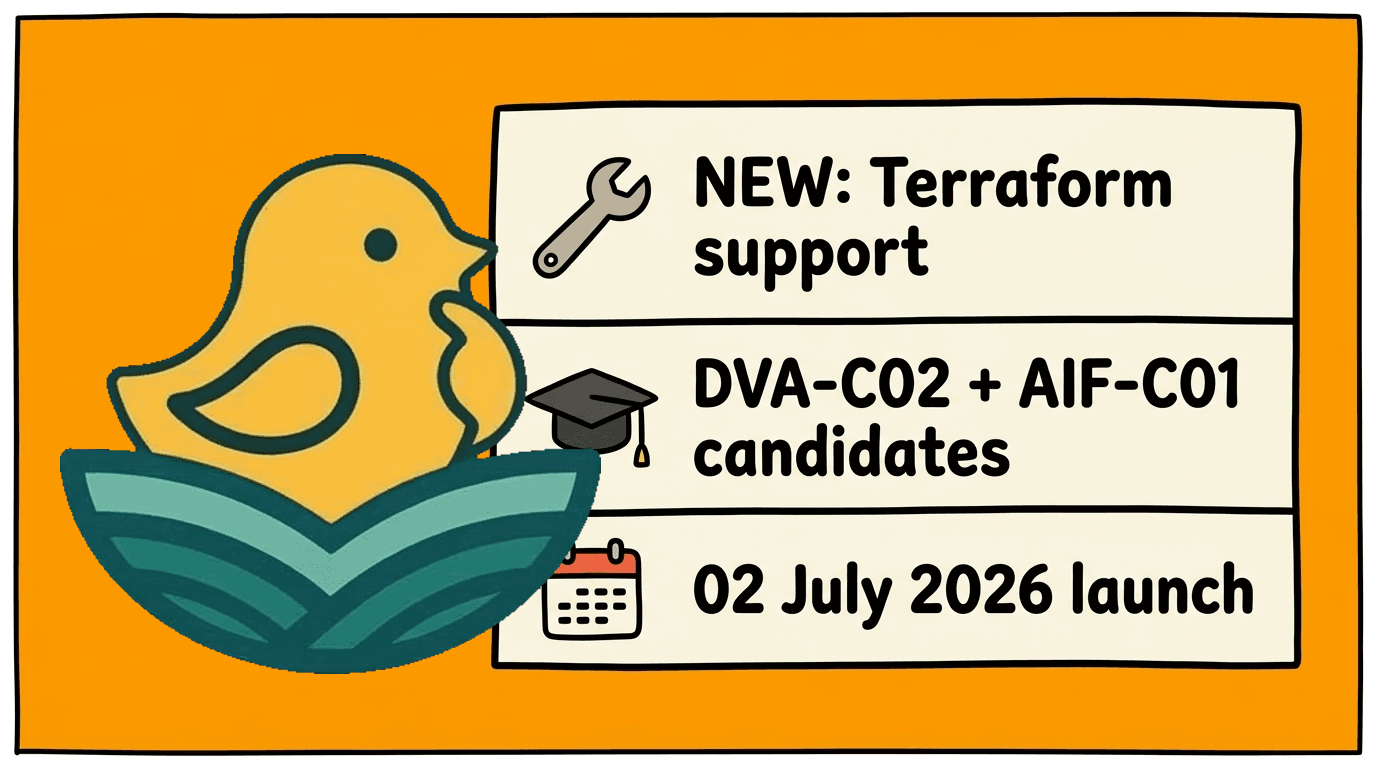
AWS just put Terraform inside SageMaker Unified Studio. Here is what that means for DVA-C02 and AIF-C01.
Reading is good. Practising is better.
Practice questions, flashcards and timed exams for 57 certifications. Start with a free starter pack — no card needed.