
AB-410 Intelligent Apps Builder Practice Questions: 20 Free Questions (2026)
AB-410 is Microsoft's brand-new Intelligent Applications Builder Associate exam — the developer-focused replacement for PL-200 (Power Platform Functional Consultant), which retires August 31, 2026. Beta is open now and general availability is June 2026. Where PL-200 tested classical low-code app development, AB-410 expects you to ship AI-first solutions: Copilot-embedded apps, AI Builder models, embedded Copilot Studio agents, Power Automate flows authored from natural language, and end-to-end Power Platform ALM. These 20 hand-authored practice questions are weighted to match the AB-410 course outline. Try each one, then read the explanation. The full 250-question AB-410 bank is at readroo.st/marketplace/ab-410-intelligent-apps-builder.
Try 5 Free Questions
Question 1 of 5A company uses business units to represent regional offices. An administrator needs to configure a security role so that regional directors can view account records in their own business unit and any child business units. Which privilege depth should the administrator configure for the Read privilege?
Select your answer below
AB-410 replaces PL-200 — what is different
AB-410 (Build Intelligent Applications) earns the Microsoft Certified: Intelligent Applications Builder Associate credential. It replaces PL-200 (Power Platform Functional Consultant), which retires August 31, 2026. The audience is similar — Power Platform Functional Consultants, App Makers, Business Analysts — but the surface is meaningfully different. PL-200 tested classical Power Platform app development. AB-410 tests AI-first application design.
Three additions matter. First, Copilot is now first-class everywhere — Copilot-driven Power Apps generation, Copilot embedding inside canvas apps, Copilot-driven Power Automate flow authoring. Second, AI Builder models (form processor, prediction, document automation, text generation) appear across the exam in apps and flows. Third, embedded Copilot Studio agents — surfacing agents inside Power Apps, Power Pages, and surfacing agents as connectors callable from flows — gets its own domain. Power Platform fundamentals (Dataverse, security roles, Solutions, ALM, Pipelines) all carry over from PL-200 and the AB-410 course explicitly assumes them as prerequisite knowledge.
Quick Answer Key (for Scanning After You Try the Questions)
1-B, 2-B, 3-A, 4-B, 5-B, 6-B, 7-A, 8-B, 9-B, 10-A, 11-B, 12-B, 13-B, 14-A, 15-B, 16-B, 17-A, 18-B, 19-A, 20-B.
AB-410 Exam Domain Breakdown
1. Create a foundation for intelligent applications — 25–30% (Power Platform solution design with AI-enabled tools; Dataverse data modeling: tables, columns, relationships, prompt columns, row summaries, views, forms, and security) 2. Create intelligent applications — 25–30% (model-driven apps: forms, views, generative pages, charts, dashboards, and access control; canvas apps: components, Power Fx, error handling, testing with Monitor, and Copilot Studio agent creation) 3. Build business application logic and automation — 40–45% (cloud flows: triggers, connectors, approvals, flow control, troubleshooting; AI Hub: build and consume prompts and AI models in apps and flows; business and process logic: business rules, business process flows, calculated/rollup/formula columns)
The 20 questions below were authored when the exam was in beta. They remain valid practice across all three canonical domains. The ReadRoost AB-410 pack at readroo.st/marketplace/ab-410-intelligent-apps-builder is being refreshed to align with the canonical domain weights above.
Questions 1-4: Dataverse, Solutions, and Data
Domain: Configure Dataverse, Solutions, and Data | Difficulty: Foundation 1. You need to deploy a Power Platform solution from dev to test to prod. The solution contains an agent that calls a vendor API at https://api-dev.vendor.com (dev) and https://api.vendor.com (prod). Which artifact should you use to abstract the per-environment URL? A) Three separate Solutions, one per environment B) An environment variable defined in the Solution, set to the appropriate URL per environment during pipeline deployment C) A custom connector hard-coded to the dev URL D) A topic variable inside the agent
Correct Answer: B Environment variables are exactly designed for per-environment configuration like API URLs. They are part of the Solution, set by the pipeline at deployment time, and the agent or flow reads them at runtime. Three solutions duplicates work. Hard-coded connector URLs require manual edit per environment. Topic variables are runtime conversation state, not deployment-time configuration.
Domain: Configure Dataverse, Solutions, and Data | Difficulty: Moderate 2. Your AI-enhanced app processes uploaded documents that may contain PII. From an AI-aware data governance perspective, which Microsoft Purview / Dataverse capability is MOST relevant? A) Disable file uploads in the app B) Apply Microsoft Purview sensitivity labels to the uploaded documents and configure DLP policies that prevent the AI Builder document-processor from extracting fields out of "Confidential" or higher labelled content into Dataverse without explicit allowlist C) Block all access to the app for users without admin roles D) Convert all uploads to plaintext before processing
Correct Answer: B Sensitivity labels + DLP is the recommended pattern for AI-aware data governance: the label travels with the document and the DLP policy makes the AI extraction conditional on the label. Blocking uploads defeats the purpose. Admin-only restriction is too coarse. Converting to plaintext loses the labels and any structural information the AI Builder needs to extract fields correctly.
Domain: Configure Dataverse, Solutions, and Data | Difficulty: Foundation 3. You want to give app makers the ability to read and create records in a Dataverse "Customer" table but prevent them from seeing the "SSN" column. Which Dataverse capability fits? A) Column-level security: enable column-level security on the SSN column and grant access only to a security role that the app makers do not have B) Build two separate Customer tables, one with SSN and one without C) Hide the SSN column in the model-driven app D) Use row-level security with a filter expression on SSN
Correct Answer: A Column-level security in Dataverse is the supported pattern for restricting individual column access while allowing row access. Hiding columns in the form is UI-only and the column is still readable via the API. Two tables duplicate data and create sync problems. Row-level security restricts which rows a user sees, not which columns within a row.
Domain: Configure Dataverse, Solutions, and Data | Difficulty: Moderate 4. Your Solution has an unmanaged dependency on a connection reference defined in the dev environment. When the pipeline tries to deploy to test, the deployment fails because the connection does not exist in the test environment. The correct fix is: A) Manually create the connection in test before each deploy B) Add the connection reference to the Solution and resolve it during pipeline deployment by mapping it to the test environment's pre-created connection — this is the standard ALM pattern for environment-specific connections C) Move the agent out of the Solution and deploy it manually D) Hard-code the connection inside the agent and remove it from the Solution
Correct Answer: B Connection references abstract environment-specific connections from the Solution. The pipeline maps the reference to the actual connection at deployment time. Manually creating connections per deploy is unsustainable. Removing the agent from the Solution defeats ALM. Hard-coding connections inside the agent breaks portability and security.
Questions 5-9: Build AI-Enhanced Power Apps
Domain: Build AI-Enhanced Power Apps | Difficulty: Foundation 5. You want users of a canvas app to ask natural-language questions about the records in a Dataverse "Sales" table (e.g., "What were my top three customers last quarter?"). Which Power Apps feature is the right fit? A) Build a custom screen with text input + Power Fx expression B) Embed a Copilot inside the app, pointed at the Dataverse table — Copilot in canvas apps natively supports natural-language Q&A over connected Dataverse tables C) Use a model-driven view D) Build a Power Automate flow that runs a saved query
Correct Answer: B Copilot embedded in canvas apps is the supported feature for natural-language Q&A over Dataverse data — the user types a question, Copilot generates the query, runs it against the table, and renders the result in the chat surface. Custom Power Fx requires the maker to anticipate every question. Model-driven views are static. Power Automate flows are not interactive in the chat sense.
Domain: Build AI-Enhanced Power Apps | Difficulty: Moderate 6. Your app needs to extract structured fields (vendor name, total, line items) from uploaded invoices in PDF form. Which AI Builder model do you choose? A) Sentiment analysis model B) Document Processor (Form Processor / Invoice Processor) — purpose-built to extract structured fields from invoice-shaped documents, and configurable by uploading sample documents and tagging the fields you want extracted C) Text generation model D) Object detection model
Correct Answer: B Document processor / form processor models are AI Builder's purpose-built capability for extracting structured fields from invoices, receipts, contracts, and similar documents. Sentiment analysis classifies tone in text. Text generation creates new content. Object detection identifies objects in images. Document processor is the only correct choice for "extract fields from PDF invoice".
Domain: Build AI-Enhanced Power Apps | Difficulty: Foundation 7. A Power Apps maker wants to generate a working canvas app from the prompt: "An expense submission app where users upload a receipt photo, the app extracts the merchant and amount, and managers approve from their inbox." Which capability supports this? A) Power Apps Copilot — accept a natural-language description and generate a working app with screens, data connections, and flows B) Microsoft Designer C) Power BI Copilot D) Power Pages Copilot
Correct Answer: A Power Apps Copilot generates working apps from natural-language descriptions, including suggested data structure, screens, and connections. The maker reviews and refines the generated app rather than building from scratch. Microsoft Designer is for visual design, Power BI Copilot for analytics, Power Pages Copilot for portal sites — none target Power Apps app generation.
Domain: Build AI-Enhanced Power Apps | Difficulty: Moderate 8. Your AI-enhanced app uses a foundation model to generate response text. Users complain that responses occasionally invent facts (hallucinate). Which UX pattern is the recommended responsible-AI mitigation in the app surface? A) Suppress all model output that includes uncertainty markers B) Display the response with a visible confidence indicator, show the source citations the model used (or note 'no source'), and provide a one-click 'override / report' control that lets the user correct the response and feeds the correction back to evaluation C) Hide the model output and show only deterministic Power Fx output D) Add a disclaimer at the bottom of the app saying 'AI may be wrong'
Correct Answer: B Responsible AI in app UX requires three things: confidence transparency (the user knows when the model is uncertain), source citations (the user can verify), and override capability (the user can correct and feed back). Suppressing uncertain output hides the failure mode. Hiding model output entirely defeats the AI-enhancement goal. A static disclaimer is insufficient — it doesn't enable user verification or correction.
Domain: Build AI-Enhanced Power Apps | Difficulty: Foundation 9. A canvas app has a gallery showing 5,000+ Dataverse records and uses a Filter() expression with `Contains()` on a non-indexed text column. Performance is slow. Which Power Apps concept does this scenario illustrate, and what is the fix? A) Caching — add a Refresh() call B) Delegation — Contains() on a non-indexed text column is non-delegable, so the app pulls all 5,000+ records to the client and filters locally. Fix: use a delegable expression (StartsWith on an indexed column, or query an indexed column with `=`), or filter server-side in a Dataverse view C) Concurrency — wrap the gallery in a Concurrent() block D) Hydration — preload the data into a collection at app start
Correct Answer: B Delegation is the Power Apps performance concept the question targets. Contains() on a non-indexed text column is non-delegable — Power Apps pulls the dataset to the client and filters in-memory, which is slow on 5,000+ records. The fix is to use a delegable expression or query against an indexed column. Caching, concurrency, and hydration are unrelated mechanisms.
Questions 10-14: Power Automate and AI
Domain: Automate Intelligent Processes | Difficulty: Foundation 10. You want a flow to classify incoming customer emails into "Complaint", "Question", "Praise", and "Other", then route to the correct team. Which AI Builder action is appropriate? A) Text classification (custom or pre-built) AI Builder action — train on labelled examples or use a pre-built model and call from the flow with the email body as input, branch on the returned category B) OCR action — extract text from the email body C) Sentiment analysis — return positive/negative/neutral D) Form processor — extract fields
Correct Answer: A Text classification is exactly the AI Builder action for "given a body of text, return one of N predefined categories". Sentiment analysis returns three buckets and does not match the four-class requirement. OCR is for images of text. Form processor extracts structured fields, not categorize text.
Domain: Automate Intelligent Processes | Difficulty: Moderate 11. A flow calls an external API in a step that fails intermittently (~5% rate) due to transient network issues. The downstream steps depend on the API response. The cleanest design is: A) Catch the error in the next step and email the maker every time B) Configure the API call action with a retry policy (exponential backoff, e.g., 4 retries with 30s / 60s / 120s / 240s waits) and a "Run after" condition on the downstream action that requires the API call to have succeeded — and add a dead-letter branch for the case where retries exhaust C) Catch the error and use a default value for the response D) Re-architect the flow into 4 independent flows so each step is independent
Correct Answer: B Retry policies + run-after + dead-letter branch is the standard resilience pattern for transient external-service failures. Exponential backoff handles the transient case. Run-after gates dependent steps on success. The dead-letter branch handles the residual hard-failure case (e.g., emails maker, writes to a Dataverse "failed flow runs" table for review). Defaults silently can hide real problems. Splitting into independent flows breaks the orchestration semantics.
Domain: Automate Intelligent Processes | Difficulty: Moderate 12. A maker wants to build a Power Automate flow by describing it in plain English: "When a new SharePoint item is created, summarize it with AI Builder, post the summary to Teams, and require manager approval before archiving the item." Which capability supports this? A) Power Automate Designer with manual step-by-step authoring is the only path B) Copilot in Power Automate — accepts a natural-language description and generates a working flow with the trigger, AI Builder action, Teams post, approval, and SharePoint archive steps; the maker reviews and refines C) Logic Apps Designer D) Power Apps Copilot — only generates apps, never flows
Correct Answer: B Copilot in Power Automate is the natural-language flow-authoring capability. The maker describes the flow, Copilot generates a working draft, the maker refines. Power Automate Designer manual authoring is still available, but the question is asking about the Copilot capability. Logic Apps is the related Azure product but not Power Automate. Power Apps Copilot generates apps, not flows.
Domain: Automate Intelligent Processes | Difficulty: Foundation 13. A finance approval flow needs to route to the requestor's manager based on data in Microsoft Entra ID. Which approach is most reliable? A) Hard-code the manager email per requestor in the flow B) Use the "Get user profile (V2)" or "Get manager (V2)" Office 365 / Microsoft Entra connector to look up the requestor's manager dynamically and use the result in the approval action C) Maintain a Dataverse table of manager mappings updated nightly D) Have the requestor type their manager's email in the form
Correct Answer: B 'Get manager (V2)' from the Office 365 Users / Microsoft Entra connector returns the user's manager from the directory at runtime — this is always current and requires no maintenance. Hard-coding emails fails when people change roles. Mirror tables are stale by design. Asking the requestor to type the manager email allows fraud and is unauditable.
Domain: Automate Intelligent Processes | Difficulty: Hard 14. Your flow has 12 actions in a sequence. You realize 4 of them call independent external APIs and could run in parallel. The right refactor is: A) Wrap the 4 independent API calls in a "Run in parallel" branch and converge afterwards — flow execution time drops from sum-of-4 to max-of-4 B) Leave the flow sequential — Power Automate cannot parallelize C) Split the 4 calls into 4 separate child flows and call them with Run-and-Wait D) Move the 4 calls into a single Send HTTP request that fans out
Correct Answer: A Power Automate's parallel branches are the supported, native parallelization pattern. Sum-of-4 → max-of-4 latency is the practical win. Power Automate definitely supports parallel branches. Child flows with Run-and-Wait still serialize at the parent. Single Send HTTP cannot fan out without an external orchestrator.
Questions 15-18: Embed Agents and Copilot Studio
Domain: Embed Agents and Copilot Studio Experiences | Difficulty: Moderate 15. You want to embed your Copilot Studio agent inside a canvas app so users can chat with it without leaving the app. Which Power Apps control is the right embedding surface? A) Power Apps Web Resource control pointed at the agent's public URL B) Power Apps Copilot control (also called Bot / Agent control), configured with the agent's deployment ID — Copilot Studio agents have a first-class embed path inside Power Apps that handles auth and conversation state C) IFrame control pointed at the agent's test URL D) Power BI tile pointed at the agent
Correct Answer: B The first-class agent-embedding control in Power Apps surfaces a Copilot Studio agent natively, with auth and conversation state managed by the platform. IFrames around the public test URL break authentication and don't carry the user's identity context. Web resources are model-driven-app patterns. Power BI tiles are for analytics, not chat.
Domain: Embed Agents and Copilot Studio Experiences | Difficulty: Foundation 16. A Power Pages portal needs to surface a Copilot Studio agent that answers customer support questions and is grounded against your public knowledge base. Which integration is recommended? A) Send users to the agent's standalone chat URL B) Configure the Copilot Studio agent for Power Pages embedding via the Power Pages Copilot configuration, ground the agent against the public knowledge base via generative answers, and embed the chat surface directly in the portal C) Build a custom React component that calls the agent's REST API D) Have the agent post to Microsoft Teams and link the Teams thread from the portal
Correct Answer: B Power Pages has a first-class Copilot Studio agent integration. The agent is grounded via generative answers (Azure AI Search or other RAG sources), the chat surface embeds in the portal, and authentication is handled by the platform. The other options are workarounds: a redirect breaks the in-portal experience, a custom React component reinvents the platform feature, and a Teams handoff is wrong audience for a public portal.
Domain: Embed Agents and Copilot Studio Experiences | Difficulty: Foundation 17. Your Copilot Studio agent needs to call a custom internal API. To make the agent invokable from a Power Automate flow as well, the recommended cross-product reuse pattern is: A) Build a Power Platform custom connector for the internal API, register it as a tool on the Copilot Studio agent, and expose the same connector as an action in Power Automate — single connector, multiple consumers B) Build the integration once in Copilot Studio with Send HTTP request, then duplicate it in Power Automate C) Build it twice — once in each product D) Forward Copilot Studio calls into Power Automate via webhook
Correct Answer: A Custom connectors are the cross-product reuse mechanism — once built, both Copilot Studio (as a tool) and Power Automate (as an action) can consume them. The other options duplicate work or introduce indirection that has no benefit. The platform-design lesson is: build the API integration once at the connector layer, then consume it from any Power Platform product.
Domain: Embed Agents and Copilot Studio Experiences | Difficulty: Hard 18. Your tenant wants 30+ embedded agents to all be able to surface internal SharePoint and OneDrive content. Building a Power Platform custom connector for each integration would be wasteful. The recommended platform pattern is: A) Each agent gets its own custom connector B) Register a Microsoft 365 Copilot connector (Graph connector) at the tenant level for the SharePoint and OneDrive content; all agents in the tenant can surface the indexed content via that single Copilot connector — register once, consume everywhere C) Each agent uses Send HTTP request and hard-codes the SharePoint URLs D) Use Power Automate to copy the SharePoint content into Dataverse nightly so agents can query Dataverse
Correct Answer: B M365 Copilot connectors (the rebranded Graph connectors) are tenant-level integrations specifically designed for the 'many agents, one source' reuse pattern. The connector indexes the source once and any tenant agent can surface the indexed content. Per-agent custom connectors duplicate setup. Send HTTP per agent is fragile. Mirror copies of SharePoint into Dataverse are stale and ungoverned.
Questions 19-20: Govern, Test, and Lifecycle
Domain: Govern, Test, and Manage Lifecycle | Difficulty: Foundation 19. Your AI-enhanced app has 2,000 active users. Before deploying a change to a custom prompt that drives the app's response generation, the responsible-AI testing approach is: A) Create a test set of representative prompts and known-good responses (or rubrics for free-form output), run the test set on the new prompt configuration, compare against the baseline, and require a human review of any regressions before promoting to prod B) Deploy directly and monitor production for complaints C) Test only with the maker's own example inputs D) Skip testing because the change is just a prompt edit
Correct Answer: A AB-410 testing-and-governance objectives explicitly cover representative test sets for AI responses, with comparison against baseline and human review of regressions. Deploying directly to 2,000 users with no test gate is the failure mode the exam tests for. The maker's own examples are biased; representative test sets explicitly avoid that. 'It's just a prompt edit' is the wrong mental model — prompts directly drive AI behavior at scale.
Domain: Govern, Test, and Manage Lifecycle | Difficulty: Foundation 20. Power Platform Pipelines deploys a new version of your AI-enhanced app to production. Within 30 minutes, the support queue lights up with errors. You need to roll back. The correct rollback path is: A) Manually edit the production app to undo each change B) Use Power Platform Pipelines to re-deploy the previous Solution version (Pipelines retains version history) — single action, restores the prior known-good state across all included artifacts C) Drop the production environment and re-create from scratch D) Email each user instructions to refresh the app
Correct Answer: B Power Platform Pipelines retain version history, and the rollback path is to re-deploy the prior known-good Solution version — exactly like a versioned application deploy. Manual undo is error-prone and partial. Dropping the environment is destructive. User-side refresh does not roll back server-side state.
How Did You Score?
17-20 correct: Exam-ready. Book your AB-410 beta seat and use the full 246-question ReadRoost AB-410 pack at readroo.st/marketplace/ab-410-intelligent-apps-builder to drill the remaining edge cases. Pay particular attention to the cross-product patterns (custom connectors as tools in agents AND actions in flows; M365 Copilot connectors as tenant-wide reuse) — those are the highest-information-density questions on the exam.
12-16 correct: Solid foundation. The two domains that catch most candidates are Embed Agents and Copilot Studio Experiences (~18%) and Build AI-Enhanced Power Apps (~25%). If you are coming from PL-200 you may know Dataverse and Solutions cold but be weaker on AI Builder + Copilot embedding patterns — that is the study target. The full pack drills scenario-based questions across all five domains.
Under 12 correct: Start with the AB-410T00 official Microsoft Learn course (3 days), then Microsoft Foundry, AI Builder, and Copilot Studio learning paths. AB-410 is Microsoft's newest associate-level Power Platform exam, and it explicitly assumes intermediate-comfortable familiarity with Power Apps, Power Automate, Power Pages, Dataverse, and basic Copilot Studio as prerequisite knowledge. If you are new to Power Platform, plan to invest 8-12 weeks of focused study. Our companion AB-620 practice questions at readroo.st/blog/ab-620-practice-questions-free cover the deeper Copilot Studio agent-development side, which complements AB-410's app-developer focus.
Frequently Asked Questions
Is AB-410 worth taking now if PL-200 is still active?
Yes if you are starting fresh — AB-410 reflects how Power Platform actually works in 2026 (Copilot-everywhere, AI Builder embedded across apps and flows, agents surfaced as connectors). If you have already invested in PL-200 study and are within four weeks of being PL-200-ready, sit PL-200 before August 31, 2026 — the credential remains valid after retirement. If you are more than four weeks out, switch to AB-410 immediately; about 70% of PL-200 study material carries over (Dataverse, Solutions, ALM, security roles, basic Power Apps and Power Automate), and the four-week study delta on Copilot, AI Builder, and embedded-agent topics closes well within the time you would have spent finishing PL-200.
How does AB-410 differ from AB-620 (AI Agent Builder Associate)?
They are complementary developer-focused certifications on the Microsoft AI track. AB-410 is the app-builder exam — building Power Apps and Power Automate flows that embed AI and agents. AB-620 is the agent-builder exam — designing and shipping standalone Copilot Studio agents with deep MCP, A2A, Foundry, and ALM integration. If your job is "Power Platform app developer who is moving toward AI", AB-410 is the right fit. If your job is "agent developer building enterprise-grade Copilot Studio solutions", AB-620 is the right fit. Many developers will earn both.
What is the relationship between AB-410 and AI Builder?
AI Builder is Microsoft's set of pre-built AI models exposed as Power Platform actions and components — form processor, document processor, prediction, text classification, sentiment analysis, text generation. AB-410 explicitly tests both how to use these models inside apps and flows, and the responsible-AI considerations around them (confidence, citations, override, governance). You should be comfortable picking the right AI Builder model for a given use case, configuring it (uploading sample documents, training, evaluating) and consuming it from canvas apps, model-driven apps, and Power Automate flows.
AWS Microcredentials: the free, hands-on badge most people missed
Four AWS security services changed in a single week. Here is what SAA-C03 and SCS-C03 candidates need to know.
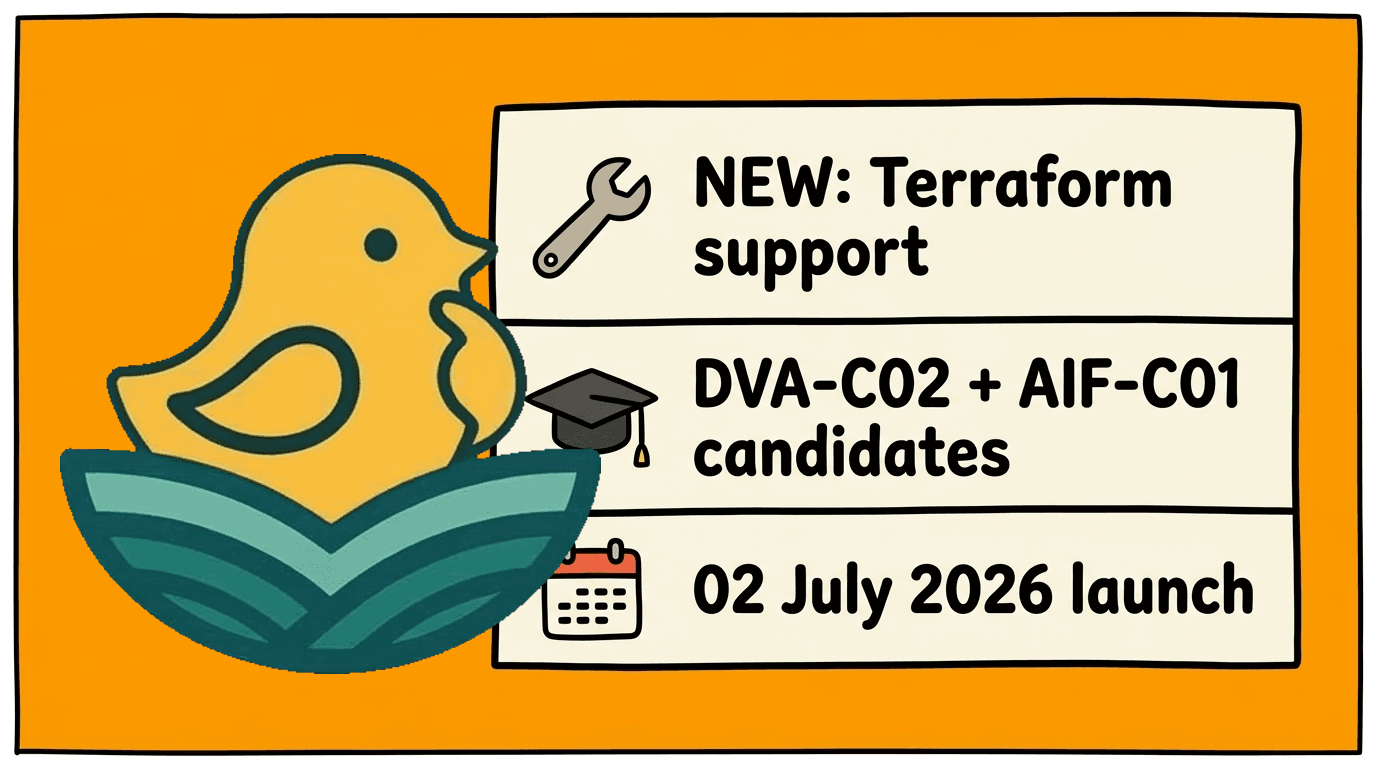
AWS just put Terraform inside SageMaker Unified Studio. Here is what that means for DVA-C02 and AIF-C01.
Reading is good. Practising is better.
Practice questions, flashcards and timed exams for 57 certifications. Start with a free starter pack — no card needed.